Invaluable support: the activities of the brass band ladies’ committee

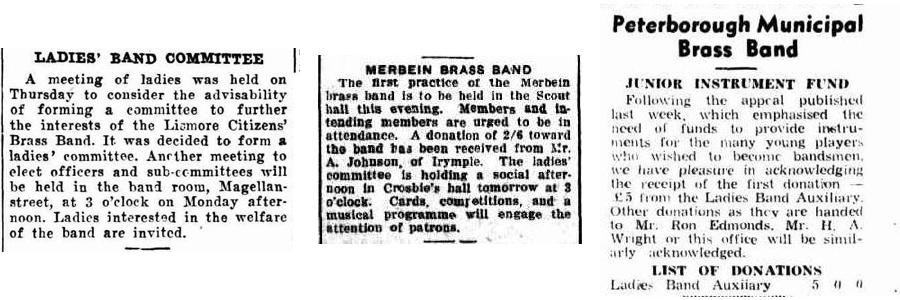
Figure 1: Northern Star, 26/07/1930, p. 8; Sunraysia Daily, 26/07/1932, p. 1;
Times and Northern Advertiser, 13/09/1946, p. 2

Introduction:

It would be a difficult matter to adequately express the appreciation we have for the efforts of our ladies’ committee.  Their help, both financially and socially, places us under a debt of deep gratitude.  It was mutually agreed that their fund should be transferred to the band’s account, and they handed over £25 /9.  The ladies also donated £20 to the building fund, and there was another gift of £4 4/ – a total of £49 13/.  The ladies should be proud of this work.

(“EXCELSIOR BAND ACTIVITIES,” 1936)

So stated Mr. A. E. Sanders, then Secretary of the Port Pirie (S.A.) based B.H.A.S. Excelsior Band. And rightly so, it was a substantial amount of money for those times to be provided to the band.  Bands all over Australia, since they began, were always in need of funds, and they worked hard to provide for themselves.  However, here we have a group, the ladies’ committee, who were not playing members of the band, but an associated entity, nonetheless.  There were many of these ladies’ committees, or auxiliaries – the naming is interchangeable – associated with brass bands across the nation during a good seventy year of the last century.  This post focuses on the important fundraising and social activities they undertook.

These ladies’ committees should not be viewed purely through gendered glasses as they were set up in different times.  In the history of our band movement, we know that while there were early female brass bands, it was largely a male orientated activity.  But there is a wealth of evidence that shows the womenfolk were very supportive of the band movement, not only actively listening to the bands, but also providing material support, which they were very good at doing.  In fact, we could view the ladies’ committee as a kind of club as the women involved not only supported the band, but being part of a committee was a social activity as well.

In this post, we will find that the ladies’ committees involved themselves in a range of activities to support their brass bands, and that their support was integral and deserved much thanks.  The evidence of their activities comes from the newspaper articles of the day and reports of annual general meetings – like the one provided by the B.H.A.S. Excelsior Band.  What we do not have is pictures of these fine folk.  Photographs of bands are easy to find. Finding pictures of their supporters is much more difficult.  Nevertheless, this post will highlight a measure of support for bands that is perhaps underrated and lost to time.  It is important to acknowledge the work of these women.

Seeing a need:

As detailed in a previous posts, bands were in need of some essentials in order to function – instruments, sheet music, and uniforms (de Korte, 2018b).  We must not forget places to rehearse as well (de Korte, 2020b).  All these things came with costs attached and while bands were reasonably good at dealing with local councils to obtain funds, more money was always needed and welcomed.  Such was the perilous state of some band finances that they could not survive monetary shocks or social upheaval (de Korte, 2020a, 2020c).  So having varied sources of funding was always going to be of benefit.

Let us work with a theory through this post, and the evidence will become clear, that the bands of this time that had two committees worked quite effectively.  For the simple fact that a band committee, which, due to the time, was male and they largely focused on the running of the band.  Having a ladies’ committee that focused on fundraising and social events meant that the time and energy of the band committee was somewhat freed up. 

The need was clearly there; it was just a matter of forming ladies’ committees who were enthusiastic about supporting the brass band.  According to a letter writer who wrote to the Glengarry, Toongabbie and Cowwarr Journal newspaper in 1925, ladies were quite fond of music, especially that of a brass band (A Member’s Wife, 1925).

Bands and their ladies:

There is no definitive time as to when the earliest brass band ladies’ committee started but newspaper articles provide us with indicative dates.  In an article published by the Sydney Morning Herald newspaper in July 1899, we find that the Newtown Brass Band of Sydney was the benefit of a ball “arranged and carried out by a committee of ladies of which Mrs. W. Rigg was the hon. Secretary, and Mrs. Trindall the hon. Treasurer” (“NEWTOWN BRASS BAND.,” 1899) with the aim of providing funds for the band to obtain new uniforms.  Admittedly. The Newtown Brass Band was already well supported by the local community – Dr. Trindall was the MC for this event and Mr. Rigg M.L.A. “made a few remarks” in support of the band (“NEWTOWN BRASS BAND.,” 1899).

For the newly formed Quairading Brass Band located in the town of Quairading, east of Perth, a ladies’ auxiliary was formed not long after the band came into existence in 1919.  And as reported in the Eastern Districts Chronicle newspaper, this auxiliary applied themselves to arranging the concerts with great success (“District News,” 1919).

The Essendon City Band, based in the north west suburbs of Melbourne, had quite the proactive band committee, and reported as such at the 1922 annual general meeting by the then (retiring) secretary, Mr. W. H. Gore, jun. (“ESSENDON CITY BAND,” 1922).  However, it was Mr. Gore’s wife, Mrs. Gore who took some initiative to help the band.

On August 22, Mrs. Gore proposed a gift sale to raise funds.  The proposal was adopted, and a ladies committee formed.  In the short time available the sum of £78 10s 6d was raised (including £9 proceeds of house party organised by Mr. Skehan), and £6 17s was also donated from R.S.S.I.L.A.  Mrs. Gore reported that in moving amongst the people she found that the upmost good-will existed towards the band, and the citizens generally were appreciative of its work in the district.  Some of the public bodies were endeavouring to make arrangements to work conjointly with the band in promoting the social life of the community, and it remained for the committee to make the best and most equitable arrangements possible.

 (“ESSENDON CITY BAND,” 1922)
Figure 2: Essendon Gazette and Keilor, Bulla and Broadmeadows Reporter, 07/12/1922, p. 1

The South Caulfield Brass Band located in the east of Melbourne, decided to form a ladies’ committee to help put on a concert at the Caulfield Town Hall in September 1927 as the band needed to pay off the debt on instruments (“South Caulfield Brass Band.,” 1927).  Their invitation to interested parties, which was detailed in an article published by The Prahran Telegraph newspaper, was welcoming.

Any lady interested in the work of the band is requested to communicate with the secretary, if desirous of assisting.

(“South Caulfield Brass Band.,” 1927)

The South Caulfield Brass Band was not the only band to form a ladies’ committee for help with special events.  In the same year, the Healesville Brass Band also formed a ladies’ committee, and they were much more organised as they voted in office bearers – “President, Mrs. Verity; vice-president Mrs. Hal Brown; secretary and treasurer, Mrs. R. Coates.” (“HEALESVILLE BRASS BAND.,” 1927).  This committee was quite firm in their fundraising aims:

The main objects of the ladies’ committee is to provide members of the band with suitable uniforms and to purchase new instruments.  It is confidently expected that the ladies of the district will support the band to their utmost ability.

(“HEALESVILLE BRASS BAND.,” 1927)

Sometimes, the main objectives to starting a ladies’ committee were a bit more open ended.  The Lismore Citizens’ Brass Band, as can be read in the article below, held a meeting to “consider the advisability of forming a committee to further the interests” of the band – with the end result of forming a ladies’ committee (“LADIES’ BAND COMMITTEE,” 1930).
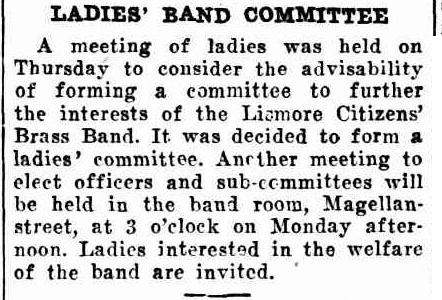
Figure 3: The Northern Star, 26/07/1930, p. 8

In the town of Merbein, located in the far north west of Victoria, the newly reconstituted Merbein Brass Band was the recipient of an equally enthusiastic ladies’ social committee that   immediately decided to hold a “social, in aid of band funds” (“BRASS BAND LADIES’ COMMITTEE,” 1932).  The social was to consist of “Cards, competitions, and a musical programme” to “engage the attention of patrons” (“MERBEIN BRASS BAND,” 1932).  This would have been a successful event given that way the town swung behind their band.
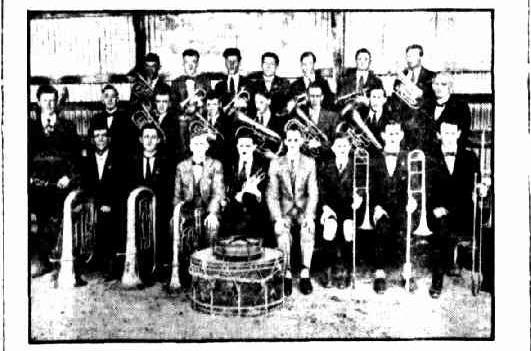
Figure 4: Merbein Public Brass Band-August 1926. Sunraysia Daily, 07/09/1926, p. 1

Support for the brass bands often came from people who held important positions in towns.  Such was the case in Shepparton, Victoria, where the then Lady Mayoress, Mrs. D. Summers invited interested women to be part of a new ladies’’ auxiliary and presided over the meeting – the ladies’ auxiliary was to take the place of the existing social committee of the Shepparton Brass Band (“SHEPPARTON BRASS BAND,” 1935).  Within one month of starting, in November 1935 this new auxiliary got to work almost immediately to raise funds in order to provide 27 uniforms for the band (“BAND UNIFORMS,” 1935b).  For the Shepparton Brass Band, there was a sense of urgency to provide the uniforms.  In January 1936 they were to host a meeting of all the bands from the Goulburn Valley and it was important that the Shepparton Brass Band looked as good as possible (“BAND UNIFORMS,” 1935a).  The new ladies’ auxiliary, and the band itself had their work cut out for them soliciting the support of the townsfolk.

The middle years of last century brought about upheaval with the advent of the Second World War, but for the bands, they recognized that additional help was needed to operate.  And they continued to form ladies’ committees to help the bands.  Mr. W. J. Moore, then secretary of the Berry Brass Band outlined in his report at the 1937 Annual General Meeting of the band how new committees would assist the band.

We would like to recommend the formation of a Citizens’ Committee, and also a Ladies’ Auxiliary, in the near future.  What can be done by such adjuncts is shown in Casino, where there is a juvenile band of 63 performers, and 25 clamouring for admission.  We must get the people of Berry interested in their band.  With the formation of theory classes at regular intervals, and the hearty co-operation of the general public, the band should flourish and provide a never-failing source of enjoyment to those who appreciated the inspiring strains of outdoor music.

(Moore in “Berry Brass Band,” 1937)

Some very worthwhile aims for the then Berry Brass Band to achieve.

Another band based in the Riverina region of New South Wales voted at their meeting in 1940 to form a ladies’ auxiliary, but it was only mentioned in the minutes with no clear goal as to what this auxiliary should aim for.

It was moved by Mr. McLay and seconded by Mr. Turner, that the lady supporters of the band be given the authority to form a committee to be known as the Narrandera Citizens’ Brass Band Women’s Auxiliary.

(“Citizens’ Band,” 1940)

The newly inaugurated ladies’ auxiliary of the Norseman Brass Band in Western Australia formed post WWII and found their work in supporting the band as well as providing a social group for lady supporters of the band, thus providing two avenues of connection (“Norseman Brass Band Ladies Aux. Formed,” 1949).

This is only a small sample of little stories relating to the formation of ladies’ committees across the Australian band movement.  For the various reasons they were formed, the fact that these committees were comprised of volunteers who gave their time for the band and social connection was the most important aspect of all.

The many ways to raise funds:

Figure 5: Members of the Casterton Vice Regal Band Ladies’ Auxiliary preparing supper at the CVRB “Belle of Belles Ball”. Weekly Times, 20/09/1950, p. 20

Balls, socials, bazaars, carnivals, baby competitions, singing competitions, cake stalls, and assisting at concerts…if there was any way to raise funds for brass bands, the ladies’ committees were on to them.  And they had a good time doing it too as the committees, as mentioned, functioned as a kind of social club.  The takings from such events were not insignificant, and the funds were much appreciated by the bands.

Some of the events that were held have already been detailed in this post as ladies’ committees were initially formed to fund specific items for the band – instruments and uniforms were particularly important. All things considered, most of the events were held just to raise additional funds which the bands used at their will. 

The ladies committee of the Port Pirie Proprietary Brass Band held a very successful social event at Port Pirie’s International Hall in March 1906.  Not only were 90 people present and £21 raised, but the ladies’ committee also presented something very special to the band.

The chief event of the evening came as a great surprise to all in the shape of a very handsome drum major’s staff, being presented to the Band by Mesdames J. Holwell and C. Langford on behalf of the Ladies’ Committee.

[…]

The Chairman in a very neat speech called upon Mr Fred Lewsey as an old supporter of the Band to make the presentation on behalf of the ladies, to the band, through their Conductor and Bandmaster, Mr. Thos Morgan.  Both gentlemen thanked the donors for the valuable and handsome present,  and expressed the hope that wherever the staff was carried it would be the means of bringing good luck and victories to the Proprietary Band.

The Bandmaster then called on Mr Tom Everon, drum-major of the Band, to accept the present custodian.  Mr Everon, in responding, said it gave him the greatest pleasure of his life in having an opportunity of thanking the donors for their useful and ornamental gift, especially as the donors were ladies.”

(“The Proprietary Brass Band.,” 1906)

Running social events was a popular activity for ladies’ committees and this is evident through a range of newspaper articles which detailed what went on.  Despite World War One being underway, the Lakes Creek Brass Band Ladies’ Committee of Rockhampton held a coin social at the local Masonic Hall.  Several activities were on offer including dancing, a progressive euchre tournament, open air games, a waltzing competition, a find-your-partner competition, and musical items were provided by the band and vocalists (“LAKE’S CREEK BRASS BAND.,” 1917).

Like the Lakes Creek Brass Band Ladies’ Committee social that took place in 1917, several years later the ladies’ committee of the Bacchus Marsh Brass Band also ran a very successful social event.  In front of 80 people, musical items were presented by soloists from the band – including a mouth-organ duet – and vocal and other items were part of the entertainment (“BACCHUS MARSH BRASS BAND.,” 1934).  The obligatory thanks were provided by members of the band.

The boys voted the ladies “Jolly Good Fellows” at the close of the very enjoyable function, for they provided the good things that appeal to the boys and incidentally to grownups as well.

(“BACCHUS MARSH BRASS BAND.,” 1934)

In the early years of World War Two, any pleasant activity must have been a welcome distraction.  For the ladies committee of the Clare Brass Band, one activity was a singing competition which was held in the home of Miss M. Rowley in October 1941 (“Clare Brass Band.,” 1941).  It was not a small affair as fifty ladies attended the afternoon, and twelve of them participated in the competition where variety on order.  Some ladies presented tap dancing, others played the piano, and there was singing – “which caused much fun” (“Clare Brass Band.,” 1941).  Takings were a bit on the small side at “£1/3/6”, but no doubt appreciated by the band (“Clare Brass Band.,” 1941).
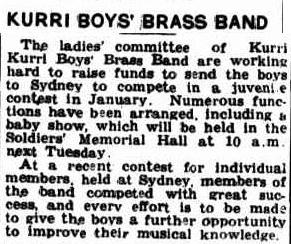
Figure 6: Cessnock Eagle and South Maitland Recorder, 04/12/1942, p. 3

The Kurri Kurri Boys’ Brass Band were very lucky to have a ladies’ committee helping them with fundraising.  Being the proactive band that they were and having the opportunity to enter band competitions on a regular basis, adequate funds were essential.  Kudos to the ladies’ committee of the band for arranging various functions, including the mentioned “baby show” (“KURRI BOYS’ BRASS BAND,” 1942).  For the record, a tiny snippet of news published in the Cessnock Eagle and South Maitland Recorder newspaper noted that the boys travelled to Sydney on the 22nd of January 1943 to compete in a competition (“PERSONAL,” 1943).  Obviously, the latest rounds of fundraising were successful in meeting goals.

In April 1950, the Clare Brass Band was in recess “due to a shortage of bandsmen”, but that did not stop their very proactive ladies’ committee from raising funds in the hope the band would become active again (“Clare Brass Band,” 1950).  They held a social afternoon that month with a variety of entertainments including “competitions, elocutionary items, songs and games” (“Clare Brass Band,” 1950).  It was noted in this article published in The Northern Argus newspaper that the Clare Brass Band Ladies’ Committee was quite proactive in what they did and how much in funds they had raised.

The ladies committee have £105 in the bank, proceeds from the social afternoons.  Many food parcels have been sent overseas, and appreciative letters have been received from the recipients.

Mrs. Shashall, President, and Mrs. H. J. Aitken, Mrs.  M. Kain, and Mrs. R. McEvoy, vice-presidents, thanked and expressed their appreciation for past help, and hoped in the near future the ladies would support their local band which is an acquisition to any town.

(“Clare Brass Band,” 1950)

On a side note, the Clare Municipal Brass Band reformed (and renamed) in 1951, then went into recess by the end of 1952, before being reformed again in November 1954 (“Clare Municipal Brass Band Reformed,” 1954; Tilbrook, 1954; “YOUNG RIDERS—AND THE BIG BRASS,” 1952).  The photograph below shows the Clare Municipal Brass Band as it was in 1952.  No doubt the ladies’ committee of the band would have been pleased to see the band reformed and know that their extensive fundraising activities helped.

Figure 7: The News, 06/08/1952, p. 12

The Horsham Brass Band Ladies’ Auxiliary was also active in the early 1950s.  As the article below shows, they held a cake  and produce stall, with the proceeds being £6 with further events planned in the lead up to Christmas (“CAKE STALL FOR BAND,” 1953).  Even small amounts of fundraising were useful for the band.

Figure 8: The Horsham Times, 04/11/1953, p. 3

With the varied forms of fundraising, the ladies’ committees contributed much to their bands as well as contributing to their localities as well.  With this help came much thanks, as was evident in these articles.  Funds for bands was an ongoing concern, and the more help that was provided, the better.

A long-standing anachonism:

It is not the greatest measurement but judging by the numbers of newspaper articles that mentioned ladies’ committees in the 1950s and 1960s, there seems to be a reduction in the numbers throughout this time.  History will tell us that from the 1950s, females started joining brass bands in greater numbers as playing band members so perhaps, this also influenced the makeup of band committees (de Korte, 2018a).  However, social factors could also be at play as society in general changed.  For example, the King Island Municipal Band noted in 1968 that the loss of their ladies’ committee was due to the lady that ran it leaving the island (On the Beat, 1968).  Change in the band movement can sometimes be gradual as new ideas take hold.

Conclusion:

This author has often heard of bands being described as a family or a community.  The stories here demonstrate that all people involved – players and helpers – are important.  The bands and their committees were wholly responsible for creating a community that supported the band.  And in times past, that support was much needed.  The ladies that volunteered to organise, run cake stalls, dances, obtained uniforms, and undertook innumerable other supporting roles did so with an enthusiasm that made a real difference. Who knows how many bands would have faltered over time had it not been for that little bit of extra support provided by a hard-working ladies’ committee?

References:

A Member’s Wife. (1925, 30 March). Coursing Club and Ladies : AND A BRASS BAND, TOO! Journal : Glengarry, Toongabbie and Cowwarr Journal (Traralgon, Vic. : 1923 – 1929), 1. http://nla.gov.au/nla.news-article274569550

BACCHUS MARSH BRASS BAND. (1934, 28 July). Melton Express (Vic. : 1915 – 1943), 3. http://nla.gov.au/nla.news-article254741515

BAND UNIFORMS : Appeal by Auxiliary. (1935a, 23 November). Shepparton Advertiser (Vic. : 1887 – 1953), 2. http://nla.gov.au/nla.news-article175424913

BAND UNIFORMS : LADIES’ AUXILIARY ACTIVE : CONCERT AND FAIR. (1935b, 15 November). Shepparton Advertiser (Vic. : 1887 – 1953),b1. http://nla.gov.au/nla.news-article175424344

Belle of Belles Chosen At Casterton. (1950, 20 September). Weekly Times (Melbourne, Vic. : 1869 – 1954), 20. http://nla.gov.au/nla.news-article224922352

Berry Brass Band : Annual Meeting. (1937, 23 September). South Coast Register (Berry, NSW : 1926; 1929 – 1931; 1933 – 1948), 1. http://nla.gov.au/nla.news-article284207960

BRASS BAND LADIES’ COMMITTEE. (1932, 19 July). Sunraysia Daily (Mildura, Vic. : 1920 – 1956), 1. http://nla.gov.au/nla.news-article265797449

CAKE STALL FOR BAND. (1953, 04 November). Horsham Times (Vic. : 1882 – 1954), 3. http://nla.gov.au/nla.news-article72774559

Citizens’ Band : Meeting of Committee. (1940, 16 February). Narandera Argus and Riverina Advertiser (NSW : 1893 – 1953), 6. http://nla.gov.au/nla.news-article130478489

Clare Brass Band. (1941, 17 October). Blyth Agriculturist (SA : 1908 – 1954), 4. http://nla.gov.au/nla.news-article222446550

Clare Brass Band. (1950, 05 April). Northern Argus (Clare, SA : 1869 – 1954), 9. http://nla.gov.au/nla.news-article97823288

Clare Municipal Brass Band Reformed. (1954, 24 November). Northern Argus (Clare, SA : 1869 – 1954), 8. http://nla.gov.au/nla.news-article97827526

de Korte, J. D. (2018a, 22 April). Early female brass bands in Australia: they were rare but they made their mark. Band Blasts from the Past: Anecdotes, Stories and Personalities. https://bandblastsfromthepast.blog/2018/04/22/early-female-brass-bands-in-australia-they-were-rare-but-they-made-their-mark/

de Korte, J. D. (2018b, 08 July). Instruments, sheet music and uniforms: how the bands of old obtained the essentials. Band Blasts from the Past: Anecdotes, Stories and Personalities. https://bandblastsfromthepast.blog/2018/05/13/instruments-sheet-music-and-uniforms-how-the-bands-of-old-obtained-the-essentials/

de Korte, J. D. (2020a, 04 June). Australian society and brass bands: The Pneumonic Influenza pandemic of 1919. Band Blasts from the Past: Anecdotes, Stories and Personalities. https://bandblastsfromthepast.blog/2020/06/04/australian-society-and-brass-bands-the-pneumonic-influenza-pandemic-of-1919/

de Korte, J. D. (2020b, 01 September 2020). A room to call their own: the space and place for bands. Band Blasts from the Past: Anecdotes, Stories and Personalities. https://bandblastsfromthepast.blog/2020/09/01/a-room-to-call-their-own-the-space-and-place-for-bands/

de Korte, J. D. (2020c, 18 October). Testing times: the resilience of Australian bands during the Great Depression. Band Blasts from the Past: Anecdotes, Stories and Personalities. https://bandblastsfromthepast.blog/2020/10/18/testing-times-the-resilience-of-australian-bands-during-the-great-depression/

District News : QUAIRADING : Brass Band. (1919, 10 October). Eastern Districts Chronicle (York, WA : 1877 – 1927), 2. http://nla.gov.au/nla.news-article148580826

ESSENDON CITY BAND : ANNUAL MEETING HELD : Year of Pronounced Activity. (1922, 07 December). Essendon Gazette and Keilor, Bulla and Broadmeadows Reporter (Moonee Ponds, Vic. : 1905 – 1924), 1. http://nla.gov.au/nla.news-article283500348

EXCELSIOR BAND ACTIVITIES : How Public Supports Music : Seventeen Concerts Bring £19 to Funds. (1936, 21 February). Recorder (Port Pirie, SA : 1919 – 1954), 1. http://nla.gov.au/nla.news-article95923315

HEALESVILLE BRASS BAND : LADIES COMMITTEE. (1927, 10 December). Healesville and Yarra Glen Guardian (Vic. : 1900 – 1942), 3. http://nla.gov.au/nla.news-article60293633

KURRI BOYS’ BRASS BAND. (1942, 04 December). Cessnock Eagle and South Maitland Recorder (NSW : 1913 – 1954), 3. http://nla.gov.au/nla.news-article99933708

LADIES’ BAND COMMITTEE. (1930, 26 July). Northern Star (Lismore, NSW : 1876 – 1954), 8. http://nla.gov.au/nla.news-article94144077

LAKE’S CREEK BRASS BAND. (1917, 03 November). Morning Bulletin (Rockhampton, Qld. : 1878 – 1954), 4. http://nla.gov.au/nla.news-article53831976

MERBEIN BRASS BAND. (1932, 26 July). Sunraysia Daily (Mildura, Vic. : 1920 – 1956), 1. http://nla.gov.au/nla.news-article265800182

NEWTOWN BRASS BAND. (1899, 24 July). Sydney Morning Herald (NSW : 1842 – 1954), 3. http://nla.gov.au/nla.news-article14228752

Nice, A. C. (1926, 07 September). MERBEIN PUBLIC BRASS BAND—August, 1926. Sunraysia Daily (Mildura, Vic. : 1920 – 1956), 1. http://nla.gov.au/nla.news-article258720934

Norseman Brass Band Ladies Aux. Formed. (1949, 09 June). Norseman-Esperance News (WA : 1936 – 1954), 2. http://nla.gov.au/nla.news-article258610441

On the Beat. (1968, 03 September). BAND HAS NOT BEEN INACTIVE. King Island News (Currie, King Island : 1912 – 1986, 2. http://nla.gov.au/nla.news-article264727496

PERSONAL. (1943, 22 January). Cessnock Eagle and South Maitland Recorder (NSW : 1913 – 1954), 3. http://nla.gov.au/nla.news-article100051247

Peterborough Municipal Brass Band : JUNIOR INSTRUMENT FUND. (1946, 13 September). Times and Northern Advertiser, Peterborough, South Australia (SA : 1919 – 1950), 2. http://nla.gov.au/nla.news-article124976509

The Proprietary Brass Band. (1906, 28 March). Port Pirie Recorder and North Western Mail (SA : 1898 – 1918), 4. http://nla.gov.au/nla.news-article95249731

SHEPPARTON BRASS BAND : Ladies Auxiliary Suggested. (1935, 03 October). Shepparton Advertiser (Vic. : 1887 – 1953), 1. http://nla.gov.au/nla.news-article175421706

South Caulfield Brass Band. (1927, 15 July). Prahran Telegraph (Vic. : 1889 – 1930), 4. http://nla.gov.au/nla.news-article165185419

Tilbrook, I. T. (1954, 10 November). CLARE MUNICIPAL BRASS BAND TO BE RE-ORGANISED : CONDUCTOR REQUIRED : (To the Editor). Northern Argus (Clare, SA : 1869 – 1954), 10. http://nla.gov.au/nla.news-article97827167

YOUNG RIDERS—AND THE BIG BRASS. (1952, 06 August). News (Adelaide, SA : 1923 – 1954), 12. http://nla.gov.au/nla.news-article130812675
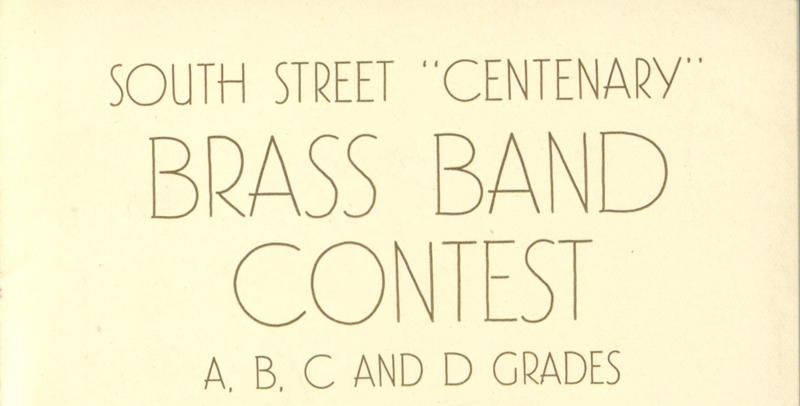
Band contests fit for a Victorian centenary: a Duke, Grenadier Guards, and the brass bands

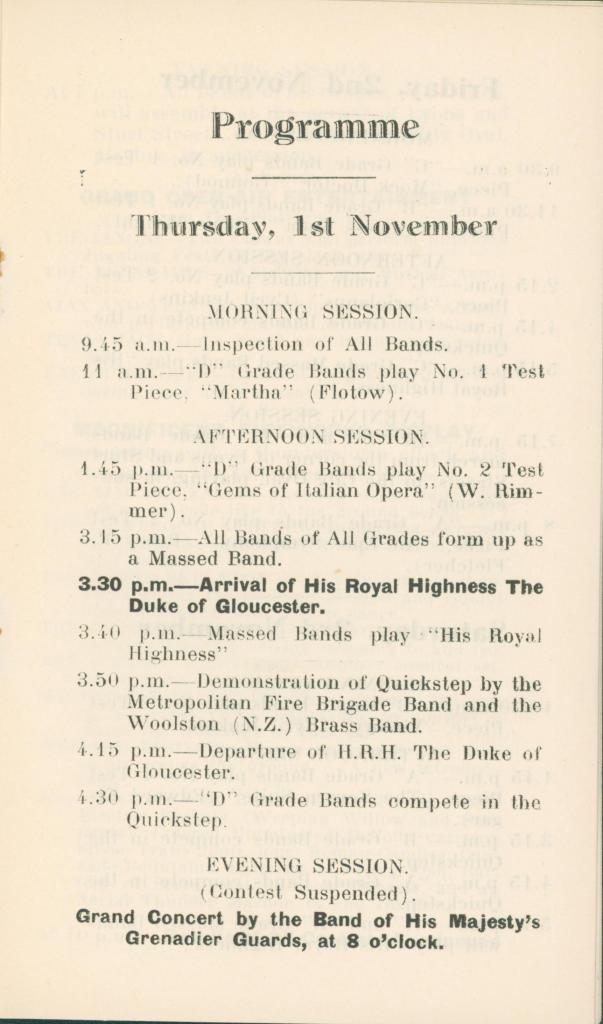
Programme: South Street “Centenary” Brass Band Contest, 1934, part of the front cover.
(Source: Victorian Collections: Victorian Bands’ League Archives)

An international band contest may be a feature of the Centenary celebrations.  An effort will be made to include one in the 1934 Eisteddfod and Band Contest at Ballarat.

The Grand National Eisteddfod of Australasia has promised its enthusiastic support of the celebrations.  Bands contests were resumed last year at the Ballarat competitions after a lapse of eight years, and they proved successful. (“Band Contest For Centenary,” 1933)

Introduction:

The year is 1934 and in Ballarat on the 1st of November, the Royal South Street Eisteddfod band sections are getting underway again.  Except this year is a bit different.  It is the year of the Victorian and Melbourne Centenary and across Victoria, celebrations and other events are in full swing.  The South Street band sections were part of these grand festivities, and all efforts were made to attract bands from across Australia and New Zealand.  In addition, the band contest was honoured by the presence of Prince Henry, Duke of Gloucester and The Band of HM Grenadier Guards.  The Royal South Street Society band contest, while being the most prestigious, attracted the most attention in the wider band movement.  For the bands themselves, there were lots of other events and band contests they were involved in.

Planning for the 1934 Ballarat band contest was extensive and as shown by the quote at the head of this post, the ideas started over eighteen months earlier.  Even if the idealism of the organisers was led astray at times.  They thought big, but had to accept that economic conditions were not the best as Australia was coming out of the Great Depression.  To put on a band contest befitting a visit of royalty was the utmost challenge.  Not to mention the scheduling given the extensive touring of the Grenadier Guards Band and the Duke. 

With the cooperation many different parties, somehow, everything worked out.  This post is mainly about the 1934 South Street band contest, ninety years to the day.

The Centenary:

Officially, the Victorian and Melbourne centenaries marked two historical events; the landing of the Henty family in Portland 1834, and John Batman’s grand pronouncement in 1835 that the Port Philip bay area with the Yarra River at its head would be “the place for a Village” (McCubbin, 2008).  However, like any celebration of this nature, there was some curious disagreement over the dates, especially from interstate commentators.  An article published in The Adelaide Chronicle newspaper in April 1934 questioned the historical accuracy of the centenary.  The article suggested that 1934 was too early as Victoria was officially proclaimed an independent colony in 1851 (“Victoria’s Centenary,” 1934).  Or maybe, as the article also suggested, the centenary was thirty-two years too late as 1802 was the year surveyors from New South Wales first explored the country in the vicinity of Port Phillip Bay (“Victoria’s Centenary,” 1934).  And there were plenty of other historical events connected with Victoria before 1834 that could have been commemorated.  The Victorian Government was probably well aware of these dates and as an article published in The Record newspaper proclaimed:

And now after warring factions have harmonised, the official foundation of Victoria is given as November 19, 1834, when the “Thistle” anchored in Portland Bay: and the centenary of this event is to be taken as the starting point of our Centenary celebrations. (“Victoria’s Centenary.,” 1933)

Nowadays Victoria celebrates an event on the 1st of July each year which marks the day Victoria was officially proclaimed an independent colony from New South Wales (Brown, 2015).  Melbourne Day is also recognized on the 30th of August each year which commemorates “the anniversary of the first European settlement in 1835” (Melbourne Day, 2024).

Confusing, isn’t it…

Prince Henry, Duke of Gloucester:

As early as 1932 if newspaper reports are anything to go by, negotiations were underway to bring a member of the Royal Family to Victoria for the Centenary commemorations in 1934.  The Scrutineer and Berrima District Press newspaper was one of these and they published a tiny article on the 6th of November 1932.

Victoria’s Centenary will probably be celebrated from October, 1934, to February, 1935.  Negotiations are in progress for a Royal visit, and it is almost certain that the British Fleet, which was to have visited Australia in 1933, will postpone the visit to coincide with the celebrations. (“Victoria’s Centenary,” 1932)

By early May 1933, the progress of the negotiations was evident to the extent that it was confirmed a member of the Royal Family would visit in 1934.  But which one?  The Victorian government initiated the negotiations; however, Canberra was also involved and any Royal that visited would be taken to the national capital as well, and to various places in Australia and New Zealand.  Speculation as to which Royal it might be was rife, and as reported by The Herald and several other newspapers, the Royal family member was going to be the Earl of Athlone, the brother of the Queen, or the Duke of Gloucester, the King’s third son (“CENTENARY PLANS TAKE SHAPE,” 1933).

In February 1934, the proposed Royal was mentioned in various newspapers as Prince George and the Royal South Street Society immediately sought to secure a visit to Ballarat by the Prince on the 1st of November so that he could open the famous band sections (“CENTENARY BAND CONTEST,” 1934).  The RSSS was concerned that the Prince, according to a tentative itinerary, might be in New South Wales while the contest was taking place.

The Age, 01/03/1934, p. 10

However, even with the best of plans, circumstances can change overnight, and by May 1934, news broke about a change of Royal, but this did not substantially alter the planning of a Royal visit.

It was announced, in the week-end, that, owing to the strain of the South African tour, Prince George would be unable to fulfil the engagement to come to Australia for the Melbourne Centenary celebrations.  Prince Henry, Duke of Gloucester, is to take his place.

The least robust member of the Royal family, Prince George felt the strain of his South African tour before it was finished.  It was far heavier than had been expected, and his letters home indicated that he was feeling tired, although delighted at the cordiality of his reception everywhere.

It was consequently considered unwise for a young man of Prince George’s temperament, which is rather highly strung, to undertake a second tour, especially as the Australasian programme was longer and more arduous than the African.

[…]

The Duke of Gloucester is the only one of the King’s sons who has not yet toured the Empire.  He fulfilled his duties during his visit to Japan so well that it was felt that he should be given the opportunity to visit Australia, where he would be likely to find so much congenial to his temperament. (“Duke of Gloucester to Come Here for Centenary Celebrations,” 1934)

With a member of a Royal family confirmed, and in all likelihood, the Duke of Gloucester would be in Ballarat on the 1st of November, planning for other parts of the Centenary celebrations and the band contest continued (“CENTENARY BAND CONTEST.,” 1934).

H.R.H. Prince Henry, Duke of Gloucester. Sunraysia Daily, 31/10/1934, p. 21

The Duke arrived in Australia in early October and visited Perth, then Adelaide on his way to Melbourne, travelling aboard H.M.S. Sussex which was escorted by elements of the Australian naval fleet (“DEPARTURE OF H.M.S. SUSSEX.,” 1934).  Prince Henry disembarked in Melbourne on the 18th of October and was afforded all the military and civic pageantry that Victoria could muster at the time. Below is a short film clip of his arrival and speech on the steps of the Victorian Parliament.

The Band of HM Grenadier Guards:

Programme: Front Cover – The Band of His Majesty’s Grenadier Guards : By Special Permission of the King, 1934. (Source: Jeremy de Korte Collection)

If the experiences of bringing a member of the Royal family to Ballarat was anything to go by, then securing a visit by one of the finest military bands in the world (at that time) was no less stressful and speculative.  Given the planning of the Centenary celebrations were well-underway in 1933, this is when newspapers started reporting that an English military band would be visiting as part of the festivities.  The Argus newspaper published a lengthy article in September 1933 that mentioned the Coldstream Guards, and that Victorian band musicians would be eager to hear them play, and be inspired (“COLDSTREAM GUARDS BAND,” 1933).  As mentioned in a previous post about this tour, only the Musicians’ Union raised objections to the tour of an English band, a position that was berated by a letter writer to The Herald newspaper (de Korte, 2018b; Musician, 1933).  In October, The Age newspaper was a little more speculative – given there are multiple guards’ bands, this article mentioned the bands of the Coldstream Guards, Welsh Guards, or Grenadier Guards as possibilities of touring (“GUARDS’ BAND VISIT.,” 1933).

It was quite a bit later, June 1934, that the Grenadier Guards Band was strongly expected to be the English military band visiting for the Centenary, and that their tour, estimated to cost £10,000 pounds, would also take in provincial towns (“FAMOUS BAND EXPECTED,” 1934).  In August, this tour was very much confirmed – one could appreciate the formality of the article published in The Age newspaper.

By special permission of the King, the band of Grenadier Guards is to give a season in Melbourne under the auspices of the Commonwealth and New Zealand Governments and the Centenary Celebrations Council, and Messrs. J. and N. Tait have been entrusted with the management of the tour.  The opening concert will be given in the Town Hall on Saturday, 20th October.  The band is the premier band of the United Kingdom, and negotiations for this visit have been carried through the Commonwealth High Commissioner in London with the British Government.  The band has no fewer than twenty different programmes.  Their uniforms of scarlet, blue and gold, with bearskin busbies, should make a fine spectacle. (“Grenadier Guards’ Band.,” 1934)

The Grenadier Guards band duly arrived in Melbourne on the 20th of October and were given a civic reception at the town hall, and a parade up Collins Street led by the Melbourne Fire Brigade Band (“GRENADIER GUARDS BAND HAS WONDERFUL WELCOME.,” 1934).  The picture below published in The Age newspaper showing the proceedings, and part of the crowd of 100,000, says it all.

The Age, 22/10/1934, p. 15

After their welcome in Melbourne and opening concert, the Band of the Grenadier Guards commenced on a country tour of Victoria, such was the interest in their visit – their first tour concert was in Wangaratta on the 22nd of October (“GRENADIER GUARDS BAND.,” 1934).  By no coincidence at all, many of the places the band visited intersected with visits of the Duke of Gloucester, including Ballarat on the 1st of November.

Of interest is the back cover of the programme used for this visit which advertises Boosey & Hawkes instruments, and the Australian music retailers that sold them – with a picture of H.M.S. Sussex which was transporting Prince Henry to Australia (Kingtson, 1934).


Programme: Back Cover – The Band of His Majesty’s Grenadier Guards : By Special Permission of the King, 1934. (Source: Jeremy de Korte Collection)

Two of the puzzle pieces for the Royal South Street band contest were now in place. But we must not forget the brass bands that were travelling to South Street for the contest.

Attracting the bands:

It would not be a band contest without the bands, and the Royal South Street Society, conscious of the significance of the 1934 contest, wanted to put on a good show.  At the head of this post was the idea that the band contest could be an international contest with the finest bands from around the world travelling to Ballarat to participate (“Band Contest For Centenary,” 1933).  Alas, bringing international bands was not to be.  Australia was just coming out of the Great Depression and economic conditions were not the best and attracting international bands was probably deemed too expensive (de Korte, 2020).  Nevertheless, in June 1933 the Lord Mayor of Melbourne gave his blessing to the band contest in Ballarat, stating,

Ballarat is looked upon as the venue for brass band contests, and I can assure you that during the centenary celebrations it will be recognised as such” said the Lord Mayor of Melbourne (Councillor H. Gengoult Smith) in speaking at a civic welcome at the city hall yesterday.  […] In recognition of what Ballarat, through the South Street Society, had done for the encouragement of brass band music, he would give his assurance that the finals of the centenary band contest would be held in Ballarat. (“CENTENARY BAND CONTEST.,” 1933)

The Mayor of Ballarat, Cr. A. J. Darling expressed confidence in January 1934 that arrangements for the official opening of the Centenary band contest were well-underway, as well as confirmation that a member of the Royal family would be attending (“CENTENARY BAND CONTEST.,” 1934).  With the Royal South Street Society and the newly formed Victorian Bands’ League working on the particulars of the contest, there was no need to think this was not the case.  And in April came the details of the prize money that was on offer, and the announcement that “Mr. Stephen Yorke, conductor of the Australian national military band, will adjudicate.” (“CENTENARY BAND CONTESTS.,” 1934).  On a side note, the A.B.C. Military Band was undertaking its own national tour in 1934 – it was a great year to listen to top bands in Australia (de Korte, 2018a).

Individual bands were also starting to make plans to visit Ballarat for the contest.  We see that in April, the Mildura Municipal Band (also known as the Sunraysia District Brass Band) announced plans to visit Ballarat to listen to the A grade sections, and then proceed to Melbourne to present a concert in conjunction with the Essendon City Band (“CENTENARY BAND CONTESTS,” 1934).  However, their ideas must have changed as they ended up participating in the contest in the C and D grade sections, and achieving equal first prize with the Pleasant Street Boys’ Band in the D grade (Royal South Street Society, 1934c). 

Photograph: Mildura & District Brass Band, 1930s. (Source: IBEW)
Photograph: Pleasant Street School Band, 1933. (Source: IBEW)
Telegraph, 13/10/1933, p. 27

Interest in competing was also expressed by bands in New Zealand as the Woolston Brass Band announced its intention to come to Ballarat for the centenary contest (“NEW ZEALAND BAND TO VISIT MELBOURNE.,” 1933).  An article published in the Dominion newspaper by the writer, ‘Kneller Hall’, speculated that the Port Nicholson Silver Band was preparing to travel to Ballarat to compete, while also confirming that the famous Woolston Brass Band was going to make the trip over the Tasman (Kneller Hall, 1934).  In the end, only one band from New Zealand ended up attending, Woolston, and they were given a civic welcome when they arrived in Ballarat (“BALLARAT AND DISTRICT,” 1934; “PROVINCIAL CITIES AND TOWNS.,” 1934a).

Woolston Brass Band. Dominion, 13/10/1934, p. 13

The South Street “Centenary” Band Contest:

With bands arriving in Ballarat, the Duke of Gloucester travelling down by train from Mildura, and the Band of the Grenadier Guards arriving from Bendigo, all was now in place for the opening of the Royal South Street band sections on the 1st of November (“GRENADIER GUARDS BAND.,” 1934; “Sunraysia, Land of Sunshine Greets The Duke,” 1934).  Twenty-two bands from Victoria, Tasmania, New South Wales, and New Zealand had entered the South Street contests this year and the list of bands and bandmasters in the official souvenir programme can be viewed below (Royal South Street Society, 1934e).

Programme: South Street “Centenary” Brass Band Contest, 1934, p. 4.
(Source: Victorian Collections: Victorian Bands’ League Archives)

To have twenty-two bands enter in 1934 was not bad considering that the early thirties were times of upheaval for the Victorian band movement and society in general.  In 1931, the Victorian Bands’ League was established having superseded the Victorian Bands’ Association, the Australian economy was recovering after the Great Depression, and the band sections at Royal South Street had resumed in 1932 after an eight year hiatus (de Korte, 2018c, 2020; Royal South Street Society, 1979).

However, it would have been pleasing to see bands from a wide variety of areas coming to South Street.  We know that for some bands, like the Phillip Island Brass Band, that they did a considerable amount of fundraising to attend (de Korte, 2019).  The line up for bands for the A Grade section represented the best of A grade bands that Victoria had in the day, and having the Woolston Brass Band from Christchurch, N.Z. made the section even more top notch.

Photograph: Phillip Island Brass Band, 1932. (Source: IBEW)

The opening day of the band contest was a spectacular affair with the Royal South Street Society having programmed all events down to the minute.  According to various newspaper articles, 10,000 people attended the opening day at Ballarat’s City Oval, no doubt drawn to the fact that the Duke of Gloucester would be there to officially open the contest.  The souvenir programme outlined the proceedings of the day as can be seen below.

Programme: South Street “Centenary” Brass Band Contest, 1934, p. 6.
(Source: Victorian Collections: Victorian Bands’ League Archives)

In superb weather, everything proceeded to plan, and the bands did their best to produce a ceremony befitting the occasion (“BAND CONTESTS,” 1934).  There was a massed band performance, a demonstration of the quickstep, and the Woolston Brass Band even performed a haka for the Duke after the march past of the bands (“DUKE AT BALLARAT,” 1934).  That night, the Band of HM Grenadier Guards performed in a concert which would have inspired the bandsmen and audience (Royal South Street Society, 1934e). 

Results for the contests were announced on Saturday 3rd of November with another 10,000 people attending to find out the placings.  The full results will not be detailed in this post due to space, but they can be found on the RSSS results database via these links:

The Solo contests were held a day before the band sections on the 31st of October.  The results of these can be found on the RSSS database via the link:

By all accounts, the standard of playing across all sections was brilliant and the adjudicator was very impressed.  The A Grade section in particular was a very hard fought affair, but in the end, the Melbourne Fire Brigade Band won the Besson Shield for the third year in a row (Royal South Street Society, 1934a).  The Woolston Brass Band from N.Z. suffered some misfortune when one of their cornet players became ill – the other A Grade bands offered them a choice of cornet players to help out – however, they decided to proceed down a player and were happy to achieve third place (“BRILLIANT PLAYING,” 1934; “PROVINCIAL CITIES AND TOWNS.,” 1934b). 

The Duke of Gloucester and the Band of the Grenadier Guards did not stay long in Ballarat as they kept up a tight schedule of touring around Victoria and eventually New Zealand.  For the bands themselves there were good stories of their visits to Ballarat.  The Yallourn and District Band from Gippsland was one band that was very proud of their efforts in the B Grade section where they achieved second place behind the City of Ballarat Band (“YALLOURN NEWS,” 1934).  Of interest is that in early 1935, three cornet players from Victorian bands, including cornetist Jack Allan of the City of Ballarat Band, were offered places in the Band of the Grenadier Guards (“Ballarat Bandsman Invited To Join Grenadier Guards,” 1935).  It is unclear whether they took up that offer.

The 1934 South Street contest was no doubt an important part of Victoria’s Centenary celebrations, but it was not the only part.  There were other important events taking place.

Events after South Street:

11th of November, 1934: Dedication of the Shrine of Remembrance, Melbourne:

Postcard: The National War Memorial of Victoria. Aerial View of Dedication Ceremony, 11/11/1934. (Source: Jeremy de Korte Collection)

For the Duke of Gloucester, he kept up a busy schedule around Victoria.  However, his most important engagement was the dedication of Melbourne’s newly completed Shrine of Remembrance.  This was a very special occasion which was attended by thousands of veterans, people, and important dignitaries.  Bands and other musicians also played an important role, and at the dedication, several Australian Army buglers sounded the Last Post standing behind Royal Australian Navy drummers.

Portland Centenary Band Contest:

The town of Portland in the far south-west of Victoria had an important part to play in Victoria’s centenary celebrations.  In turn, they staged their own band contest, albeit on a much smaller scale than the South Street contests which had concluded only two weeks earlier (“BAND CONTESTS.,” 1934).  The Portland contest was only attended by bands from Hamilton, Heywood and Mt. Gambier, and there was a pipe band contest held at the same time.  The Portland contest was won by the band from Mt. Gambier and the adjudicator was Mr. Percy Jones (“Band Contest Won By Mount Gambier,” 1934).

Melbourne Centenary Band Championship, King’s Birthday weekend, June 1935:

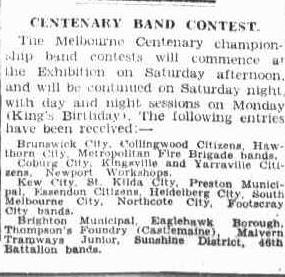
The Victorian centenary celebrations stretched into 1935, and a Melbourne Centenary Band Championship was held at the Exhibition Buildings under the auspices of the Victorian Bands’ League.  Like the South Street contests, this was another great event for bands, and twenty-one bands participated, as listed in the article below.

The Age, 28/05/1935, p. 11

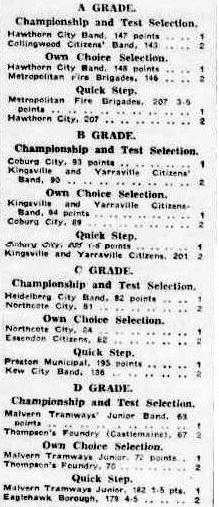
The main attraction of this event was a grand parade from Alexandra Avenue to the Exhibition Buildings and quickstep display on the Exhibition oval (“CENTENARY BAND CONTESTS,” 1935).  Again, the A Grade section continued the rivalries between Hawthorn, Melbourne Fire Brigade, Brunswick and Collingwood bands, with Hawthorn taking out the A Grade title (“CENTENARY GALA WEEK.,” 1935).  Another celebrated win was that of the Malvern Junior Tramways Band when they won their third D Grade title in a row.

The Age, 04/06/1935, p. 10

Conclusion:

What an intense period of activity for bands!  It is times like these that our bands came to the fore with all the ceremonial and contest activity, as well as local celebrations.  No doubt the communities appreciated the efforts and the entertainment.  Having a visiting band of the calibre of the Band of the Grenadier Guards made the Centenary celebrations even more special, and it was noted at the time that they were inspiring to local musicians.  The prevailing feeling when all was done was one of accomplishment, not just from the cooperation that made this all happen, but from all that understood the significance of the events.  It is not every day that a world-class military band and a Duke visits a band contest.

References:

BALLARAT AND DISTRICT. (1934, 08 June). Argus (Melbourne, Vic. : 1848 – 1957), 3. http://nla.gov.au/nla.news-article10944624

Ballarat Bandsman Invited To Join Grenadier Guards. (1935, 16 January). Sunraysia Daily (Mildura, Vic. : 1920 – 1950), 5. http://nla.gov.au/nla.news-article265838073

Band Contest For Centenary. (1933, 25 February). Sun News-Pictorial (Melbourne, Vic. : 1922 – 1954; 1956), 4. http://nla.gov.au/nla.news-article277163952

Band Contest Won By Mount Gambier : Judge’s Eulogistic Comments. (1934, 22 November). Portland Guardian (Vic. : 1876 – 1953), 4. http://nla.gov.au/nla.news-article64287397

BAND CONTESTS : OPENING AT BALLARAT. (1934, 02 November). Mercury (Hobart, Tas. : 1860 – 1954), 14. http://nla.gov.au/nla.news-article29165635

BAND CONTESTS : Three Bands Competing. (1934, 19 November). Portland Guardian (Vic. : 1876 – 1953), 5. http://nla.gov.au/nla.news-article64287383

BRILLIANT PLAYING : Ballarat Band Contest. (1934, 05 November). Evening Post, 9. https://paperspast.natlib.govt.nz/newspapers/EP19341105.2.61

British Pathé. (2014, 13 April). Melbourne Centenary (1934) [Video (Film Clip)]. YouTube. Retrieved 11 October 2024 from https://www.youtube.com/watch?v=C4DWQpyx4O0

Brown, S. L. (2015, 01 July). Victoria Day: Was secret gold behind 1851 separation from NSW? ABC Radio Melbourne,6584322. https://www.abc.net.au/news/2015-07-01/victoria-day-was-secret-gold-behind-separation/6584322

CENTENARY BAND CONTEST. (1935, 28 May). Age (Melbourne, Vic. : 1854 – 1954), 11. http://nla.gov.au/nla.news-article204361353

CENTENARY BAND CONTEST : Arrangements for Opening. (1934, 18 January). Age (Melbourne, Vic. : 1854 – 1954), 9. http://nla.gov.au/nla.news-article203377704

CENTENARY BAND CONTEST : Finals in Ballarat. (1933, 05 June). Argus (Melbourne, Vic. : 1848 – 1957), 9. http://nla.gov.au/nla.news-article4740383

CENTENARY BAND CONTEST : Proposed Opening by Prince George. (1934, 23 February). Age (Melbourne, Vic. : 1854 – 1954), 10. http://nla.gov.au/nla.news-article203376669

CENTENARY BAND CONTESTS. (1935, 31 May). Sunshine Advocate (Vic. : 1924 – 1954), 3. http://nla.gov.au/nla.news-article74757883

CENTENARY BAND CONTESTS : Mildura Band to Make Trip. (1934, 27 April). Sunraysia Daily (Mildura, Vic. : 1920 – 1950), 4. http://nla.gov.au/nla.news-article265690603

CENTENARY BAND CONTESTS : South-Street Prize Money. (1934, 13 April). Age (Melbourne, Vic. : 1854 – 1954), 7. http://nla.gov.au/nla.news-article203842698

CENTENARY GALA WEEK : BAND CONTESTS DECIDED : HAWTHORN CITY WINS A GRADE CHAMPIONSHIP : Malvern Tramway Juniors’ D Grade Treble. (1935, 04 June). Age (Melbourne, Vic. : 1854 – 1954), 10. http://nla.gov.au/nla.news-article204345548

CENTENARY PLANS TAKE SHAPE : Pageants, Exhibitions And Shrine Dedication : BIG MILITARY TATTOO. (1933, 11 May). Herald (Melbourne, Vic. : 1861 – 1954), 5. http://nla.gov.au/nla.news-article243112151

COLDSTREAM GUARDS BAND : Victorian Bandsmen Eager For Visit. (1933, 01 September). Argus (Melbourne, Vic. : 1848 – 1957), 8. http://nla.gov.au/nla.news-article11688130

de Korte, J. D. (2018a, 12 July). The A.B.C. Military Band: an ensemble of the times. Band Blasts from the Past: Anecdotes, Stories and Personalities. https://bandblastsfromthepast.blog/2018/07/12/the-a-b-c-military-band-an-ensemble-of-the-times/

de Korte, J. D. (2018b, 14 October). International band tours of the early 1900’s: bringing music to Australia. Band Blasts from the Past: Anecdotes, Stories and Personalities. https://bandblastsfromthepast.blog/2018/10/14/_international-band-tours-of-the-early-1900s-bringing-music-to-australia/

de Korte, J. D. (2018c, 15 March). The politics of affiliation: The Victorian Bands’ Association to the Victorian Bands’ League. Band Blasts from the Past: Anecdotes, Stories and Personalities. https://bandblastsfromthepast.blog/2018/03/15/the-politics-of-affiliation-victorian-bands-association-to-the-victorian-bands-league/

de Korte, J. D. (2019, 31 January). Bands on Australian islands: unique challenges in unique environments. Band Blasts from the Past: Anecdotes, Stories and Personalities. https://bandblastsfromthepast.blog/2019/01/31/bands-on-australian-islands-unique-challenges-in-unique-environments/

de Korte, J. D. (2020, 18 October). Testing times: the resilience of Australian bands during the Great Depression. Band Blasts from the Past: Anecdotes, Stories and Personalities. https://bandblastsfromthepast.blog/2020/10/18/testing-times-the-resilience-of-australian-bands-during-the-great-depression/

DEPARTURE OF H.M.S. SUSSEX. (1934, 09 October). West Australian (Perth, WA : 1879 – 1954), 17. http://nla.gov.au/nla.news-article32803514

DUKE AT BALLARAT : AMONG THE BANDS : A WOOLSTON HAKA. (1934, 02 November). Evening Post, 10. https://paperspast.natlib.govt.nz/newspapers/EP19341102.2.102.1

Duke of Gloucester to Come Here for Centenary Celebrations : AFRICAN TOUR TIRED PRINCE GEORGE. (1934, 05 May). Weekly Times (Melbourne, Vic. : 1869 – 1954), 5. http://nla.gov.au/nla.news-article223836381

FAMOUS BAND EXPECTED : Grenadier Guards for Centenary. (1934, 05 June). Herald (Melbourne, Vic. : 1861 – 1954), 1. http://nla.gov.au/nla.news-article243175540

GRENADIER GUARDS BAND. (1934, 25 October). Great Southern Advocate (Korumburra, Vic. : 1889 – 1906, 1914 – 1940), 5. http://nla.gov.au/nla.news-article255918717

GRENADIER GUARDS BAND HAS WONDERFUL WELCOME. (1934, 22 October). Age (Melbourne, Vic. : 1854 – 1954), 15. http://nla.gov.au/nla.news-article205884483

Grenadier Guards’ Band. (1934, 27 August). Age (Melbourne, Vic. : 1854 – 1954), 13. http://nla.gov.au/nla.news-article205524735

GUARDS’ BAND VISIT : Centenary Tour Almost Certain. (1933, 10 October). Age (Melbourne, Vic. : 1854 – 1954), 8. http://nla.gov.au/nla.news-article205104515

Kingtson, C. (Ed.). (1934). Grenadier Guards Band : Australia and New Zealand 1934-5 : By Special Permission of His Majesty the King : Official Souvenir : Tour under the Auspices of the Commonwealth Government and the New Zealand Government : In associaion with the Cenenary Celebrations Council of Victoria  [Printed programme]. Grenadier Guards Band. 

Kneller Hall. (1934, 27 July). THE BANDS : News and Views : WELLINGTON AND BALLARAT. Dominion, 13. https://paperspast.natlib.govt.nz/newspapers/DOM19340727.2.98

McCubbin, M. (2008). Centenary. In eMelbourne: the city past & present (pp. EM00316b). https://www.emelbourne.net.au/biogs/EM00316b.htm: The University of Melbourne, School of Historical & Philosophical Studies.

Melbourne Day. (2024). More marvellous than ever: FAQs: What is Melbourne Day? Melbourne Day: 30th August. Retrieved 26 October 2024 from https://www.melbourneday.com.au/about.html

Mildura & District Band, 1930s. (1930). [Photograph]. [phot6314]. The Internet Bandsman Everything Within, Vintage Brass Band Pictures – Australia. http://www.ibew.org.uk/vbbp-oz.html

Musician. (1933, 11 September). GUARDS’ BAND VISIT. Herald (Melbourne, Vic. : 1861 – 1954), 6. http://nla.gov.au/nla.news-article243423748

NEW ZEALAND BAND TO VISIT MELBOURNE. (1933, 13 October). Telegraph (Brisbane, Qld. : 1872 – 1947), 27. http://nla.gov.au/nla.news-article180593124

Phillip Island Brass Band, 1932. (1932). [Photograph]. [phot16005]. The Internet Bandsman Everything Within, Vintage Brass Band Pictures – Australia. http://www.ibew.org.uk/vbbp-oz.html

Pleasant Street School Band, Ballarat, 1933. (1933). [Photograph]. [phot20817]. The Internet Bandsman Everything Within, Vintage Brass Band Pictures – Australia. http://www.ibew.org.uk/vbbp-oz.html

PROVINCIAL CITIES AND TOWNS : BALLARAT. (1934a, 29 October). Age (Melbourne, Vic. : 1854 – 1954), 13. http://nla.gov.au/nla.news-article205882825

PROVINCIAL CITIES AND TOWNS : BALLARAT. (1934, 05 November). Age (Melbourne, Vic. : 1854 – 1954), 12. http://nla.gov.au/nla.news-article205083970

Royal South Street Society. (1934a). 1934-10-31 Brass Band Solos : Held at the A.N.A. Hall, Camp Street [Eisteddfod Results]. Royal South Street Society Results Database. https://results.royalsouthstreet.com.au/results/1934-10-31-brass-band-solos 

Royal South Street Society. (1934b). 1934-11-01 Brass Band Contests : Held at City Oval : Grand Champion Centenary Band Contests [Eisteddfod Results]. Royal South Street Society Results Database. https://results.royalsouthstreet.com.au/results/1934-11-01-brass-band-contests 

Royal South Street Society. (1934c). 1934-11-02 Brass Band Contests  : Held at City Oval [Eisteddfod Results]. Royal South Street Society Results Database. https://results.royalsouthstreet.com.au/results/1934-11-02-brass-band-contests 

Royal South Street Society. (1934d). 1934-11-03 Brass Band Contests  : Held at City Oval [Eisteddfod Results]. Royal South Street Society Results Database. https://results.royalsouthstreet.com.au/results/1934-11-03-brass-band-contests 

Royal South Street Society. (1934e). [South Street “Centenary” : Brass Band Contest : A, B, C and D Grades]. In S09 – Programs (Printed programme ed., pp. 14). Ballarat, Victoria https://victoriancollections.net.au/items/5d425e0c21ea6b1a84382033: Victorian Bands’ League Archive.

Royal South Street Society. (1979). Royal South Street Society : The First One Hundred Years. Royal South Street Society. 

ShrineMelbourne. (2013, 09 January). The Dedication of the Shrine of Remembrance – Remembrance Day 11 November 1934 [Video (Film Clip)]. YouTube. Retrieved 26 October 2024 from https://www.youtube.com/watch?v=jHcaXEpVdRA

Sunraysia, Land of Sunshine Greets The Duke : Prince Henry Is Our First Royal Guest. (1934, 31 October). Sunraysia Daily (Mildura, Vic. : 1920 – 1950), 21. http://nla.gov.au/nla.news-article265829018

The Shrine of Remembrance Trustees. (1934). The National War Memorial of Victoria : Aerial View of Dedication Ceremony [Postcard]. [No. 3]. The Shrine of Remembrance Trustees, Great Britain. 

To Visit Australia. (1934, 13 October). Dominion, 13. https://paperspast.natlib.govt.nz/newspapers/DOM19341013.2.116.5

Victoria’s Centenary. (1932, 06 November). Scrutineer and Berrima District Press (NSW : 1892 – 1948), 4. http://nla.gov.au/nla.news-article125232791

Victoria’s Centenary. (1933, 04 November). Record (Emerald Hill, Vic. : 1881 – 1954), 2. http://nla.gov.au/nla.news-article164468392

Victoria’s Centenary. (1934, 12 April). Chronicle (Adelaide, SA : 1895 – 1954), 39. http://nla.gov.au/nla.news-article92354462

VISIT TO BALLARAT : Desired for Band Competition. (1934, 01 March). Age (Melbourne, Vic. : 1854 – 1954), 10. http://nla.gov.au/nla.news-article203834255

YALLOURN NEWS : Yallourn Band. (1934, 08 November). Morwell Advertiser (Morwell, Vic. : 1888 – 1954), 9. http://nla.gov.au/nla.news-article71564079

Band performances and the historical curiosities of formations: squares, circles, and everything in between 

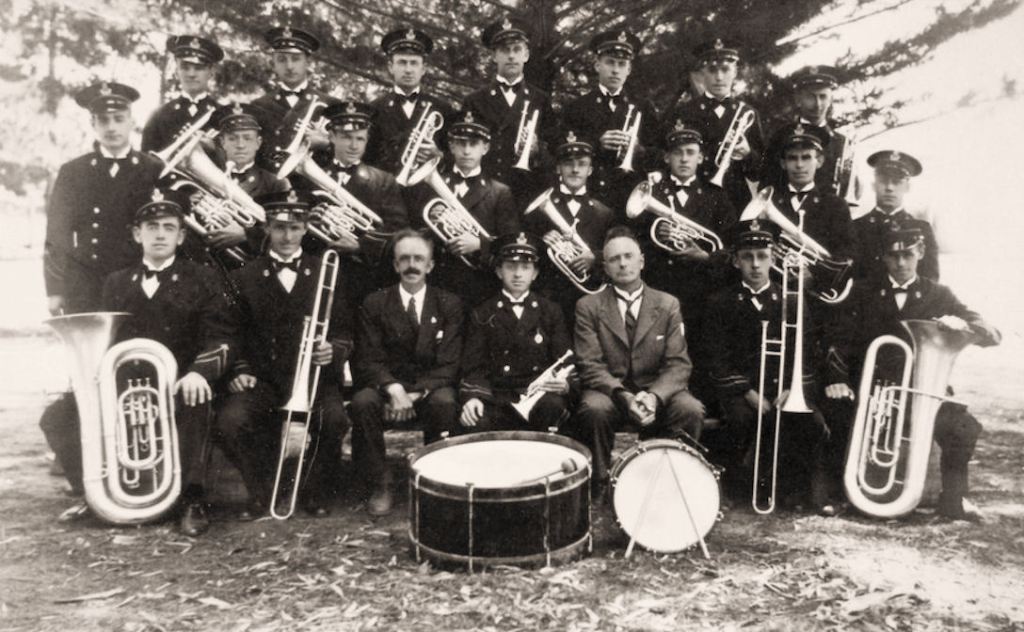
Collingwood Citizens’ Band rehearsing in a quarry, 1906 (Source: IBEW: phot19034)

Introduction:

The Prahran City Band, under the veteran conductor, E. T. Code, next took the stand.  This band showed a wise departure in abandoning the old-fashioned circle and forming in a half-moon, and consequently, every man was facing his leader, and no one was nearer the judge than his neighbour.  This method is an improvement and should be adopted by all bandsmen, and a better balance of tone will be accomplished. (“BRASS BAND CONTESTS.,” 1911)

So said a knowledgeable observer from Bendigo who was visiting the Ballarat and listening to the 1911 Royal South Street Eisteddfod band sections.  Obviously, he noticed a distinct difference in the sound of the Prahran City Band as opposed to bands that mounted the platform and stood in a circle with the conductor in the middle.  Granted, this was in 1911, so the wording is interesting.  Bands standing in circles for certain performances was the status quo then. Old fashioned? Possibly.  However, as with anything in the band movement, any significant change took time, and Australian bands generally followed developments from England. Is it ironic that the status quo was shaken up by an Australian brass band visiting England? There is more to that story.

Playing within the confines of band rotundas and on the elevated platforms used at band contests meant that bands performed in all sorts of shapes – circles, squares, the half-moon (thanks to Prahran City Band), and other formations.  As a historical curiosity in the band movement, these formations bring the question of why because even though some unusual formations are necessary in modern times, in general, brass bands now perform in a generic formation wherever possible.

This post is about band formations mainly in outdoor settings, although some might say this applies to indoor performances as well.  Unfortunately, there is a lack of written information about the specifics of early brass band formations for performances – no one has written a manual (apart from marching).  Much of what can be discussed comes from the anecdotal evidence of photographs and the odd review of contests.  The assumption then can be made that when bands formed up on elevated platforms and in band rotundas, formations were dictated by the platform’s shape and the conductor’s discretion.

Elevation:

One common element that has stood the test of time is the elevation of a musical ensemble for performances.  A stage or platform tends to mean that bands (and orchestras, choirs, etc.) are better heard and seen by the audience.  The Kalgoorlie Miner newspaper noted as such when reviewing a performance by the A.W.A. Brass Band in September 1903 prior to this band making the long journey to compete in Ballarat.

The advantages of an elevated position for band performers in submitting their programmes to the judgement of the public was made abundantly manifest at the Boulder Recreation Reserve last night when the various items in the bill were given from a temporary rotunda or covered-in platform, erected by the Boulder Orchestral society, to facilitate the object of the gathering last evening, and also for use when the members of that particular organisation take up the running in the absence of local bands at the Ballarat competitions.  The players were not hemmed in and incommoded by spectators, and the music was conveyed with better effect. (“THE A.W.A. BRASS BAND.,” 1903)

Bands had also noted the advantages of band rotundas and bandstands, and the visit of the Besses o’ th’ Barn Band to Victoria was a catalyst for further work (de Korte, 2021).  According to an article published in The Age newspaper in October 1907, Code’s Brass Band lamented the lack of facilities for performances.

It was mentioned that the great enthusiasm aroused by the playing of the Besses o’ th’ Barn Band should have the effect of showing the authorities that good band music is appreciated by the general public, and drawing their attention to the lack of facilities in Melbourne for bands to give open air performances.  What is badly needed is the erection of suitable rotundas or band stands in public parks and reserves.  At present when a band gives an open air performance, an unsightly temporary stand must be erected, or they must play standing on the grass, a proceeding not at all satisfactory either to the musicians or their audiences. (“CODE’S BRASS BAND.,” 1907)

Band Rotundas:

Band rotundas, by nature of design, were largely elevated structures, some more than others.  Rotundas are also a classic example of where the structure somewhat dictated how a band was arranged.  Older band rotundas in Australia were often designed in an octagon with the central performance area occupied with a ring of music stands and space for the conductor in the middle.  Whenever a rotunda was opened in a locality, it was a special occasion as it meant the local band had a proper performance space, as this article published in The Daily Telegraph newspaper about the new structure constructed by the Newtown Brass Band shows.

A desire having been expressed that it should give more frequent public performances, arrangements have been made for it to play every week in one of the local parks – Victoria Park, Marrickville, and Erskineville.  Hitherto the band has suffered under a great disadvantage when playing in the open by not having a proper stand.  The result was that the players were liable to be encroached upon by the crowd, causing much inconvenience, whilst the music was not heard at its best. The attempts to get a stand provided for them having failed, the members, who included several tradesmen, set about constructing one of their own.  They did all the work themselves, the only cost being that of the materials.  They have succeeded in producing a structure admirably adapted for its purpose.  It is octagonal in shape and will accommodate about 40 performers.  It can be taken to pieces without much trouble, and removed on one day, the work of fixing it up occupying only about a quarter of an hour.  There is an outer platform, on which the players will stand, uprights carrying supports for the music, whilst the conductor, from a smaller stand in the centre, has everything under his control. (“NEWTOWN BRASS BAND.,” 1904)

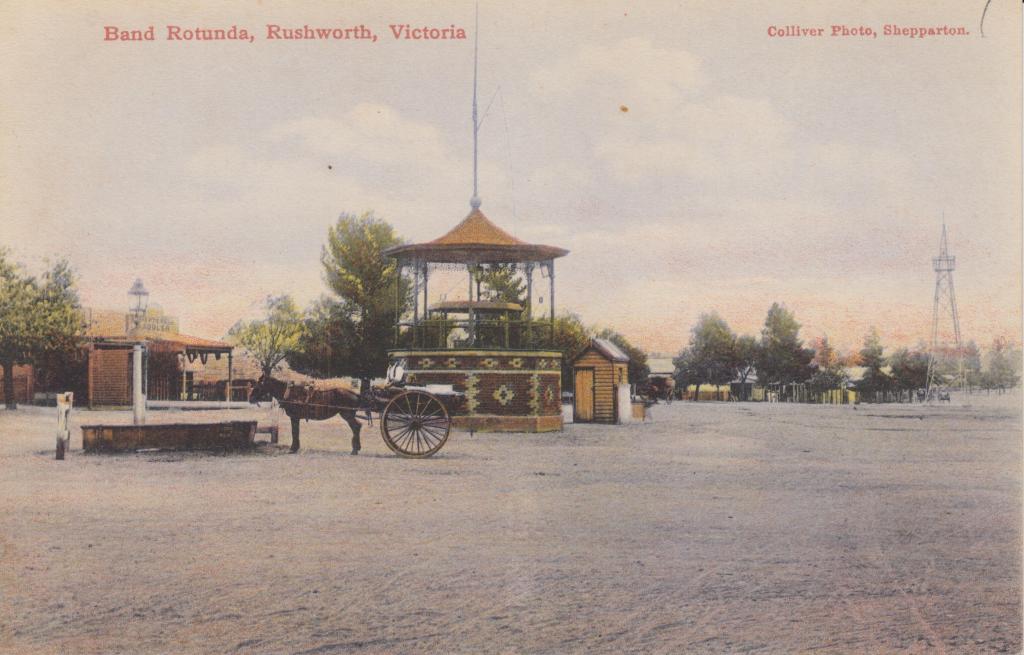
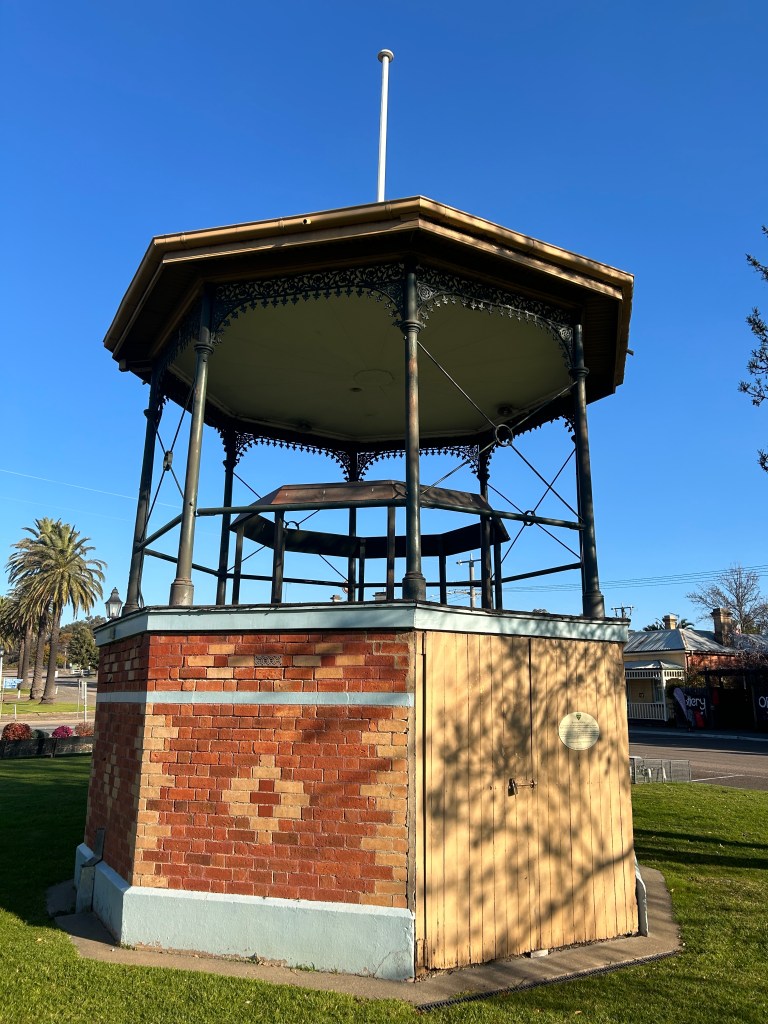
The band rotunda at Rushworth in northern Victoria is an example of this style of design.  Below is a postcard dating from 1907 and a later photograph of the rotunda – thankfully, the ring of music stands has not been removed over a century later (de Korte, 2024c).

Postcard: Band Rotunda, Rushworth, Victoria, 1907. (Source: Jeremy de Korte Collection)
Photograph: Queen Jubilee Band Rotunda.
(The photograph was taken by Jeremy de Korte, 26/05/2024)

It can be seen that this particular rotunda is a bit on the small size, and when visiting the town, this author was told by townspeople that the current Rushworth and District Concert Band does not play up on this rotunda at present due to space constraints.  As with any structure of this type, they are of all different sizes and designs.  Images of band rotundas from all over Australia can be viewed on the companion blog, Australian Band Stands: Iconic structures in towns and cities.

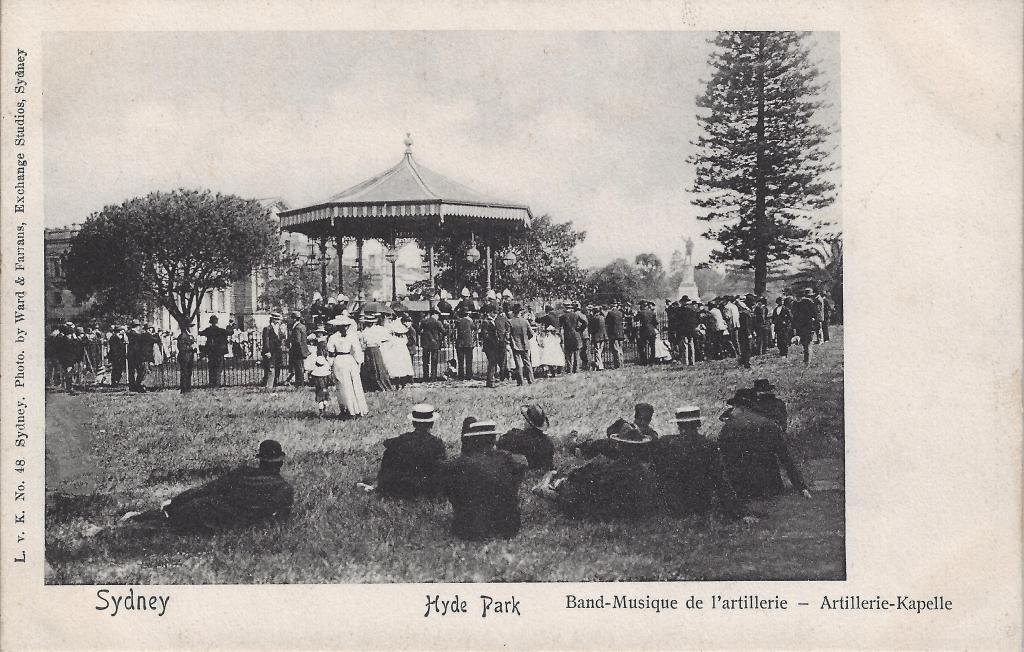
What a band might have experienced when playing on a rotunda like this can be viewed below where we can see the New South Wales Artillery Band playing at the Hyde Park Rotunda.  The band members can just be seen standing around the edges of the rotunda facing inwards towards the conductor.

Postcard: Sydney : Hyde Park : Band-Musique de l’artillerie – Artillerie-Kapelle, (date unknown). (Source: Jeremy de Korte Collection)

Platforms:

Bands playing on temporary platforms was quite common, and again, still is to a certain extent.  Like playing on rotundas, platforms tended to dictate the shape in which a band performed.  Circles and rectangles tended to be the norm, but as the Prahan City Band demonstrated, other formations were used (“BRASS BAND CONTESTS.,” 1911).  Perhaps the Collingwood Citizens’ Band, seen in the photograph at the head of this post, was rehearsing in a circle in preparation for a contest.

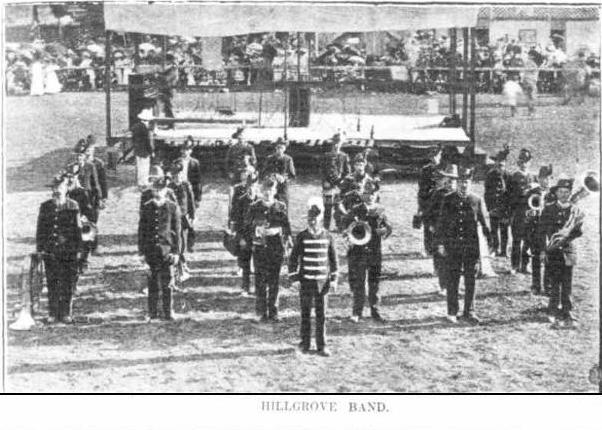
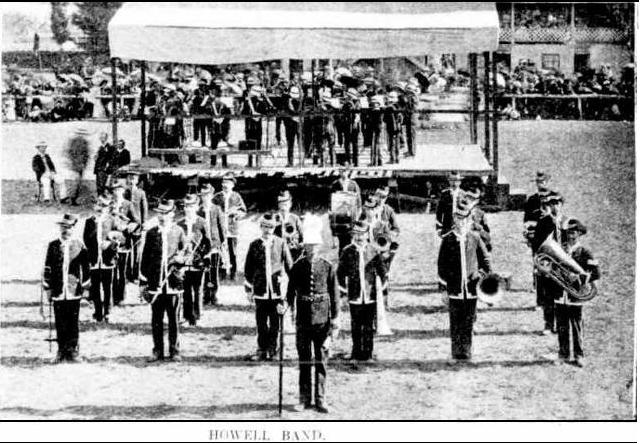
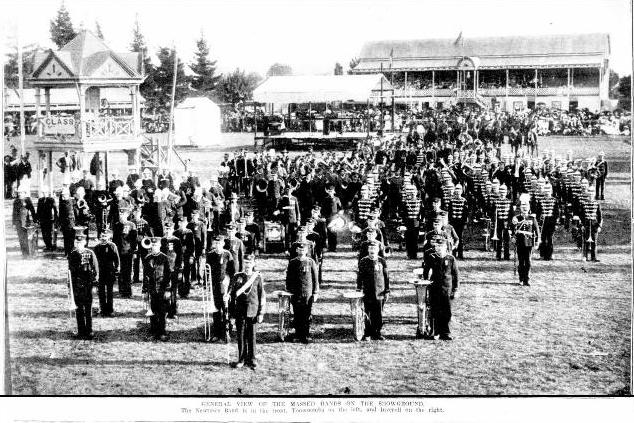
Thankfully, there are some newspaper articles and photographs that show bands performing on an elevated platform at a contest.  The series of photographs below taken at the Inverell (N.S.W.) Musical Festival in 1907 and published in The Sydney Mail and New South Wales Advertiser newspaper is a perfect example. As we can see, the bands are on the platform formed up in a circle.  The temporary platform is in full view, and when each band is getting their photograph taken, the next band is taking their turn on the platform.  The photographs are displayed here separately, and the photograph of the massed bands has also been included.

Hillgrove Brass Band – Inverell Musical Festival.
The Sydney Mail and New South Wales Advertiser, 10/04/1907, p. 925
Narrabri Enterprise Band – Inverell Musical Festival.
The Sydney Mail and New South Wales Advertiser, 10/04/1907, p. 925
Emmaville Miners’ Brass Band – Inverell Musical Festival.
The Sydney Mail and New South Wales Advertiser, 10/04/1907, p. 925
Howell Brass Band – Inverell Musical Festival.
The Sydney Mail and New South Wales Advertiser, 10/04/1907, p. 925
Massed Bands – Toowoomba Australis (left), Newtown Brass Band (front), Inverell Austral Band (right)  – Inverell Musical Festival.
The Sydney Mail and New South Wales Advertiser, 10/04/1907, p. 925

Likewise, the 1911 Kalgoorlie Brass Band Competitions and Eisteddfod was well-documented by photographer Mr. R. Vere Scott, and his photos were published in the Kalgoorlie Western Argus newspaper (Scott, 1911b).  On a side note, this contest was notable as it not only included some Western Australian bands but also the Broken Hill Band, which made the long journey to Kalgoorlie, as can be read about in a previous post (de Korte, 2019).  One of the photographs that Mr. Scott took was of the Boulder City Band taking their turn on the contest platform on the main oval (Scott, 1911a).  From looking at this photograph, one wonders how much the audience heard as the band members were all facing the conductor in the middle, and only some of the band members were likely to be pointing their instruments at the audience in the stands.

Boulder City Band – Kalgoorlie Brass Band Competitions and Eisteddfod.  Kalgoorlie Western Argus, 10/10/1911, p. 21

Elevating an ensemble was important enough for the musicians and the audience.  Yet there was the issue of sound production as well.  It could be assumed that it was possibly easier to hear a band playing on rotunda due to the roof reflecting sound outwards.  But what about a band playing in a shape on a platform?  How much of that was heard? Would it be better for a whole band to project outwards, generally in one direction?

1924, the year formations changed:

Band competing at Crystal Palace National Contest 1902.
(Source: IBEW – the History of Brass Bands blog)

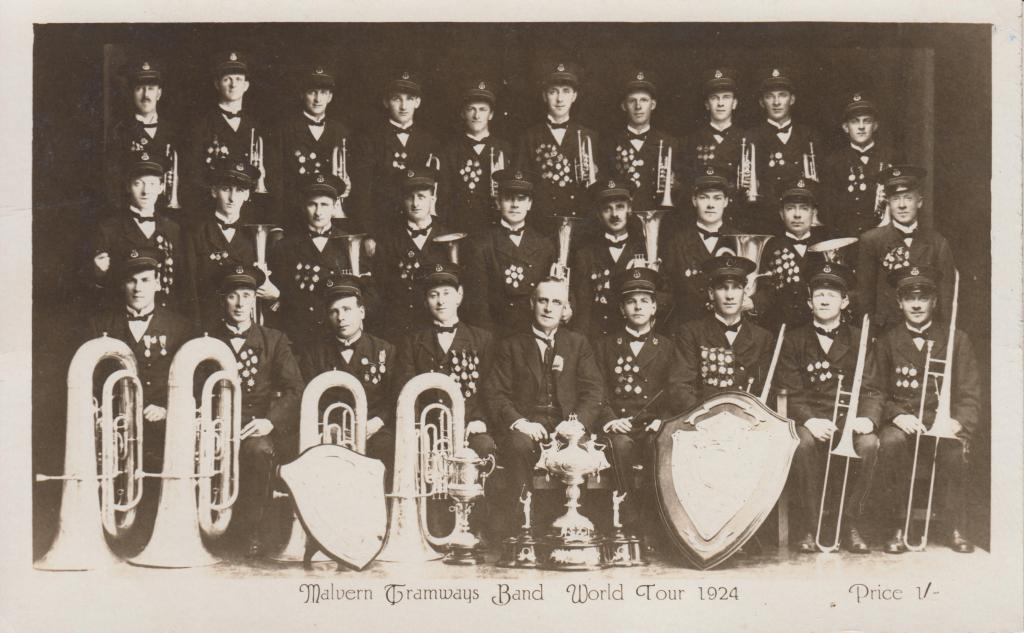
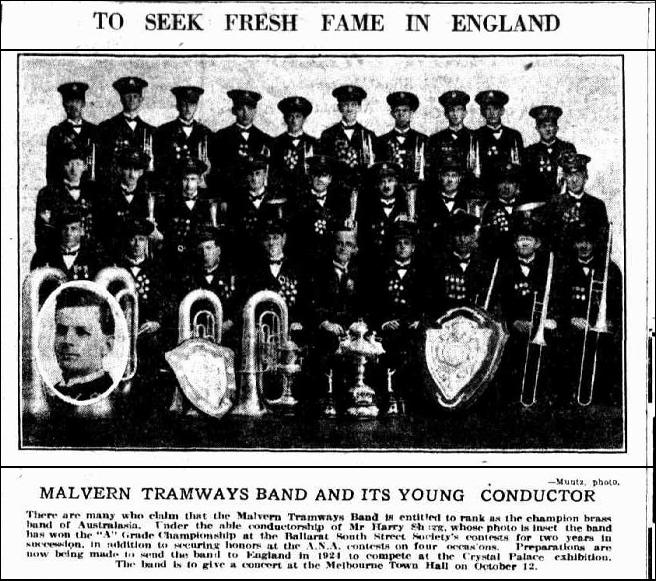
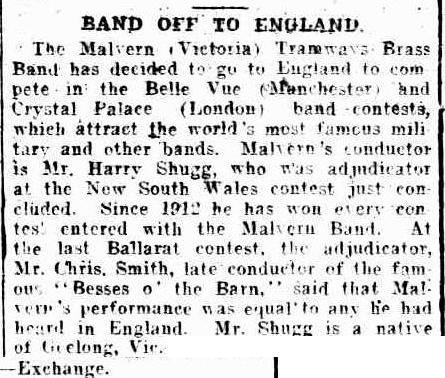
Much happened in 1924.  The Malvern Tramways Band did not travel to the United Kingdom to compete in the famous English band competitions, as they were widely expected to do (de Korte, 2024a).  However, the Newcastle Steel Works Band did travel to England and caused a stir when they got there, mainly for the fact that they won two of the major championships and came third in another major championship (Greaves, 2005).  This was in addition to the numerous concerts and other events the band played at to earn some money during the tour – the trip was very expensive (Bythell, 1994; Helme, 2017).

While the Newcastle band astonished the English band aficionados with their playing, they did something else that changed the band world forever; they went on stage at the Belle Vue contest in Manchester – their second contest of the tour – and sat in a concert formation (Greaves, 1996).

Now, admittedly, the band had sat in concert formations at previous concerts in England, but this was the first time the band had sat in this formation at a contest.

Although they had already sat in formation at previous contests, the audience at the King’s Hall were still taken aback when the Newcastle Steel Works players arrived on stage – each carrying a wooden chair.  They then proceeded to sit in the now ‘traditional’ formation before Albert Baile took the stage. (Mutum, 2024)

The Australian band historian Jack Greaves (1996) provides us with a more detailed description of the event and the implications of what Newcastle set in motion.

The year 1924 also saw the introduction by the Australian visitors of a new innovation at the Belle Vue contest.  Up till then, it was customary for bandsmen to stand in a circle on the contest platform during the entire rendition of the test selection.  Tradition was broken by the visitors, however, for when their turn to play came, each man carried on to the platform his own chair and the band then arranged itself into a horseshoe formation.  As they were the second last band to play, it meant that each bandsman had the responsibility of retaining possession of his own chair for most of the day, which also meant carrying it about with him wherever he went.  From then on, all bands at Belle Vue have played seated.” (pp. 49-50)

There is no record as to which Newcastle band member thought up the new formation, although one would suspect that Conductor Albert Baile was the instigator.  Various accounts, however, do mention the band being coached by conductors James Ord Hume and William Rimmer prior to the Belle Vue contest – did they also have an influence? (Bythell, 1994; Greaves, 2005).  Interestingly, the hall at the time was one of those arenas where the audience could watch the band from all four sides, so having a band perform on chairs in a concert formation must have been a novelty for them (Helme, 2017).  One of the reasons (nominally the weakest reason) the English commentators used to justify Newcastle’s win was the different seating formation (Bythell, 1994). 

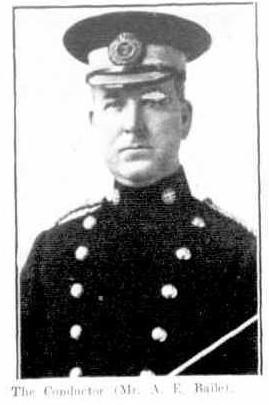
So yes, it did take an Australian band visiting England to change the seating formation of brass bands.  Below are photographs of the Newcastle Steel Works Band and their conductor Albert Baile upon their return to Australia in 1925 as published by The Observer newspaper.

Newcastle Steel Works Band. Observer, 10/01/1925, p. 34
Albert Baile. Observer, 10/01/1925, p. 34

Conclusion:

What is evident from this little story is that evolution in the band world takes time and can happen quite suddenly.  This was not a movement that did not copy developments in the orchestral world where orchestras had been sitting in a concert formation for centuries.  As can be seen in the photographs from England and Australia, playing on an elevated platform was part of the performance practice.  Playing in a shape with the conductor in the middle, which was a part of contests for the best part of three decades was something that could have been changed quite easily.  However, for some reason, it was accepted musical practice for the benefit of the conductor, and possibly an adjudicator, but not for an audience sitting at a distance.

We can thank the innovations of the Newcastle Steelworks Band a century ago for changing the playing formations.  What they did went from novelty to accepted practice very quickly. 

References:

Band Contest, Yallourn. (n.d.). [Photograph]. [phot8000]. The Internet Bandsman Everything Within, Vintage Brass Band Pictures – Australia. http://www.ibew.org.uk/vbbp-oz.html

BRASS BAND CONTESTS : THE BALLARAT COMPETITIONS : A BENDIGONIAN’S IMPRESSIONS. (1911, 31 October). Bendigo Independent (Vic. : 1891 – 1918), 3. http://nla.gov.au/nla.news-article226819795

Bythell, D. (1994). Class, community, and culture: The case of the brass band in Newcastle. Labour History(67), 144-155. http://www.jstor.org/stable/27509281 

CODE’S BRASS BAND. (1907, 11 October). Age (Melbourne, Vic. : 1854 – 1954), 9. http://nla.gov.au/nla.news-article204997427

Collingwood Citizens’ Band rehearsing in a quarry. (1906). [Photograph]. [phot19034]. The Internet Bandsman Everything Within, Vintage Brass Band Pictures – Australia. http://www.ibew.org.uk/vbbp-oz.html

Colliver Photo. (1907). Band Rotunda, Rushworth, Victoria [Postcard]. [194458]. W. T. Pater, Printers and Stationers, Shepparton, Victoria; Melbourne, Victoria. 

de Korte, J. D. (2019, 06 September). Trans-continental connections: the brass bands of Broken Hill and Kalgoorlie. Band Blasts from the Past: Anecdotes, Stories and Personalities. https://bandblastsfromthepast.blog/2019/09/06/trans-continental-connections-the-brass-bands-of-broken-hill-and-kalgoorlie/

de Korte, J. D. (2021, 16 February). Influences from Britain: James Ord Hume and “The Besses Effect”. Band Blasts from the Past: Anecdotes, Stories and Personalities. https://bandblastsfromthepast.blog/2021/02/16/influences-from-britain-james-ord-hume-and-the-besses-effect/

de Korte, J. D. (2024a, 28 February). Hype versus reality: why the Malvern Tramways Band never travelled to the United Kingdom. Band Blasts from the Past: Anecdotes, Stories and Personalities. https://bandblastsfromthepast.blog/2024/02/28/hype-versus-reality-why-the-malvern-tramways-band-never-travelled-to-the-united-kingdom/

de Korte, J. D. (2024b). Rushworth, Vic. : Queen Victoria Jubilee Band Rotunda [Photograph]. [IMG_9916]. Jeremy de Korte, Newington, Victoria. 

de Korte, J. D. (2024c, 11 April). Rushworth, Victoria – Queen Victoria Jubilee Band Rotunda. Australian Band Stands: Iconic structures in towns and cities. https://australianbandstands.blog/2024/04/11/rushworth-victoria-band-rotunda/

Greaves, J. (1996). The Great Bands of Australia [booklet] [2 sound discs (CD) : digital ; 4 3/4 in. + 1 booklet]. Sydney, N.S.W., Sound Heritage Association Ltd. https://catalogue.nla.gov.au/catalog/2372005

Greaves, J. (2005). A musical mission of Empire : the story of the Australian Newcastle Steelworks Band. Peters 4 Printing. https://catalogue.nla.gov.au/catalog/3640204 

Helme, C. (2017, 23 September). The Newcastle Steelworks Band from Australia and its 1924 visit to the UK. Chris Helme : Sunday Bandstand, 229. http://www.chrishelme-brighouse.org.uk/index.php/sunday-bandstand/bandstand-memories/item/229-the-newcastle-steelworks-band-from-australia-and-its-1924-visit-to-the-uk

Holman, G. (2020, 15 April). The Crystal Palace and bands. IBEW – the History of Brass Bands. https://ibewbrass.wordpress.com/2020/04/15/the-crystal-palace-and-bands/

MUSICAL FESTIVAL AT INVERELL. (1907, 10 April). Sydney Mail and New South Wales Advertiser (NSW : 1871 – 1912), 925. http://nla.gov.au/nla.news-article165387808

Mutum, T. (2024, 30 August). The day the Open changed forever. 4barsrest, 2067. https://4barsrest.com/articles/2024/2067.asp

NEWTOWN BRASS BAND : OPENING OF A NEW BAND STAND. (1904, 22 April). Daily Telegraph (Sydney, NSW : 1883 – 1930), 3. http://nla.gov.au/nla.news-article237811793

RETURN OF THE CHAMPION NEWCASTLE STEEL WORKS BAND. (1925, 10 January). Observer (Adelaide, SA : 1905 – 1931), 34. http://nla.gov.au/nla.news-article166315185

Scott, R. V. (1911a, 10 October). BOULDER CITY BAND. Kalgoorlie Western Argus (WA : 1896 – 1916), 21. http://nla.gov.au/nla.news-article33398332

Scott, R. V. (1911b, 10 October). KALGOORLIE BRASS BAND COMPETITIONS AND EISTEDDFOD. Kalgoorlie Western Argus (WA : 1896 – 1916), 21. http://nla.gov.au/nla.news-article33398332

THE A.W.A. BRASS BAND. (1903, 28 September). Kalgoorlie Miner (WA : 1895 – 1954), 6. http://nla.gov.au/nla.news-article88873523

Ward & Farrans Exchange Studios. (n.d.). Sydney : Hyde Park : Band-Musique de l’artillerie – Artillerie-Kapelle [Postcard]. [No. 48]. L. v. K., Sydney, N.S.W. 

Hype versus reality: why the Malvern Tramways Band never travelled to the United Kingdom

Introduction:

Postcard: Malvern Tramways Band World Tour 1924 (Source: Jeremy de Korte Collection)

Sir.  I desire to bring under the notice of our authorities and your readers the splendid status of the Malvern Tramways Band, and that public interest may be awakened with a view to sending the Australia’s champion band to contest against England’s best at the famous Crystal Palace brass band contest in London.  Our soldiers and sailors, actors and singers, riflemen, footballers and politicians have won fame for Australia, and I feel confident our bandsmen can add fresh lustre to our laurels, and at the same time advertise our resources.  The time is opportune to show the mettle of our pasture on the English contest platform, where the best in the world compete.  In Malvern band we have the men, and in Mr. Harry Shugg we have the man.  Yours, etc., J. STURT ANDERSON

(Anderson, 1920)

This letter by Mr. Anderson was published in the Prahran Telegraph newspaper on the 6th of November 1920, two weeks after the afore mentioned Malvern Tramways Band won the A Grade Section at the Royal South Street contests.  His letter is telling for many reasons, namely, for the high-praise language that he used, and because he advocates for the band to travel to the United Kingdom (U.K.).  This is for a band that in 1920 is only nine years old, yet up to this point, had a contesting record which was enviable in the Australian band movement.  What Mr. Anderson probably foresaw, but could not have known at the time, was that Malvern Tramways Band was going to get better in the very near future…and they did.

As will be seen throughout this post, there is an ongoing tussle between hype and reality, and expectation could probably be mixed into this as well.  On one hand, we have a highly regarded brass band that is lauded at every opportunity for their playing. With this reputation, commentators and others talk up the prospect of sending the MTB to the U.K. compete and try to predict how well they will do when they get there.  This is the hype.  One reality, as we will find, was that the MTB was that good. However, the other reality is that travel overseas for any ensemble was expensive, as we saw in a previous post.

This is the story of why the MTB never travelled the U.K. within a time frame that spans the best part of a decade from 1920-1927.  In this post we will unpick the reputation of the MTB in the 1910s and 1920s, their contesting record, and the inter-related stories of other bands that were also trying to travel.  We will also see where the travel plans took them and the talk about the personalities that were involved.  This is a band that gained an amount of support for their endeavours and plans. Alas that it never came to be.

The Malvern Tramways Band: building a reputation:

Postcard: Malvern Tramways Band World Tour 1924 : Contesting Record.
(Source: Jeremy de Korte Collection)

Above is the contesting record of the Malvern Tramways Band up to 1922 which was printed on the back of a souvenir postcard published in 1924. This record established the reputation of the MTB as one of the finest brass bands in Australia at the time.  When considering the range of measures the MTB had in their favour during these years, including fine musicians and conductors, as well as a very active committee and the industry that supported the band, the advantages immediately become obvious.

Just looking at the conductors by themselves up to 1922, the MTB had the very best.  From their inception in 1911 to 1914, they were conducted by Mr. William Ryder of Besses o’ th’ Barn Band fame, a musician who was detailed in a previous post (de Korte, 2018b).  He led the band to its first contest win in 1912 in C grade after only thirteen practices where they surprised everyone – the Victorian Bands’ Association promptly promoted the band to B grade (Zealley & Ord Hume, 1926).

Herald, 23/10/1920, p. 4

The second conductor of the MTB was the great Mr. Robert McAnally who took over for a short stint up until 1915 when Mr. Harry Shugg started a very long association with the band that lasted thirty-one years (Lawson-Black, 2010).  These three famous musicians provided a foundation of musicianship and conducting for the band that set the MTB on a path to greatness in the early years of the band.  By the time Mr. Shugg started at Malvern, he had already several successes at South Street with the Geelong Harbour Trust Band (Quickstep, 1920).  Out of the three of these men it was Mr. Shugg that had the greatest impact and it is during his tenure that the MTB was primed to travel to the U.K.

Herald, 24/07/1920, p. 11

The Malvern Tramways Band at South Street:

Thanks to visits from some of the top bands in the world at the time, namely the Besses o’ th’ Barn Band and adjudicators from the U.K. from the early 1900s and beyond, the Australian band movement underwent a rapid rise in standards (de Korte, 2021).  The Malvern Tramways Band, although having started during this rise, was also a beneficiary with the mentioned conductors doing their part to take Malvern to new heights.  In addition, the South Street band sections, having been added to the eisteddfod programme in 1900, were regarded as the premier band competitions in Australia (Greaves, 1996).

If we drill down into the MTB contest results a bit deeper, it is the last three on the postcard that provide the most interest, a hattrick of wins at the Ballarat South Street Eisteddfod in 1920, 1921, & 1922 (Royal South Street Society, 1920, 1921, 1922).  Of course, their earlier contest results were important in the development of the band.  However, in terms of context, the MTB achieved a string of results that cemented their status, and prompted the speculation and commentary of when, not if, they would travel to the U.K. 

The MTB was not only renowned for their contest successes.  They were an extremely hardworking band that endeared themselves to the local community through their charity work, community singing events, performances, and parades (Lawson-Black, 2010).  And while they were nominally a band strongly supported by the Malvern tram depot, they also were strongly supported by the Malvern City Council who considered them as the council band (de Korte, 2022).

Rivalry:

By 1922, there was no shortage of bands trying to bump Malvern off its status as the champion band of Australia.  As Zealley & Ord Hume (1926) noted in the chapter on Malvern Tramways in their book ‘Famous Bands of the British Empire : Brief Historical Records of the recognized leading Military Bands and Brass Bands in the Empire’,

There have been 7 A grade contests in Victoria since Malvern has been an A grade Band (1915-1921) : Malvern was eligible to enter five of these and received 1st place on each occasion.”

(p. 60)

There were some Victorian A grade bands that were considered the main rivals of Malvern in competition namely Collingwood Citizens’ – they drew with Malvern at the 1915 South Street Eisteddfod – Hawthorn City, City of Ballarat, and St. Augustine’s Orphanage Band (Royal South Street Society, 1915, 1920, 1921, 1922).  And then there were some interstate rivals including Newtown, South Sydney, Ipswich, and perhaps it’s greatest rival of the time, the Newcastle Steel Works Band (Greaves, 2005; Royal South Street Society, 1920, 1921, 1922).  Although the Newcastle Steel Works Band only entered the South Street contests twice in these years, 1921 & 1922, they came second to Malvern both times (Greaves, 2005). However, unlike Malvern, the Newcastle Steel Works Band, then conducted by the great Albert Baile, did end up travelling to the U.K. in 1924, and won or placed in every contest that they entered (Greaves, 2005; Greaves & Earl, 2001).

Newcastle Steel Works Band, 1922 (Source: IBEW)

What if the MTB had made it to the U.K. and competed in their famed brass band contests?  Some commentators felt they were a much better band than Newcastle…

The first attempt: “To Seek Fresh Fame in England”:

Herald, 28/09/1922, p. 15

Do not believe the hype.  But no one told the newspapers and other commentators of the day.  After each of the three wins at South Street, the legendary status of the MTB only grew bigger.  So did the garnering of support to send the band to the U.K.

The letter from Mr. J. Stuart Anderson at the head of this post could be considered the start of the commentary and hype.  Sure enough, by early 1921, an announcement was made by the MTB that they would seek to go to the U.K. in 1924, news that surprised no one and was announced in newspapers up and down the country.  The article below published by the Northern Star newspaper of Lismore, N.S.W. in February 1921 being one example.

Northern Star, 14/02/1921, p. 3

In October 1922 the MTB achieved the hattrick at South Street and once again carried off the Boosey Shield (Royal South Street Society, 1922).  The MTB and its conductor Mr. Harry Shugg drew widespread praise for their win and the adjudicator, Mr. Christopher Smith, from Adelaide and a former conductor of the Besses o’ th’ Barn Band had this to say about the MTB.  Two Victorian newspapers, The Herald and The Prahran Telegraph, published his comments on the band and the musical genius of Mr. Shugg.

Malvern Tramways Band is such a cultured musical combination that it would capture English audiences by its playing.  It would do so by sheer merit.

[…]

The successful conductor is a puzzle.  To me he is only a boy, and I wonder where he gets such beautiful effects.  He is a genius in the middle of a band, seeming to be ever striving after the unattainable, and getting nearer to it all the time.  Let Melbourne send the boy and his band to London, and Londoners will take them to its collective bosom, and perhaps never allow them to leave.

(Smith in “Malvern Tramways Band.,” 1922)

The articles from the newspapers, while helpful, could only promote so much news about the band from their own correspondents.  From the MTB’s perspective, driven as they were to get to the U.K. by 1924, they needed someone who was a networker and promoter, as well as being a musician, to help them manage the tour arrangements.  That person was Mr. Gibson Young, and he got stuck straight into the job as tour manager.

Mr. Gibson Young, musical influencer:

The MTB won the 1922 South Street A Grade section in October of that year, by December, an announcement was made that Mr. Gibson Young would be the “business manager and organiser of the world tour” (“A BAND ABROAD,” 1922).  In Mr. Young, the MTB could not have made a better choice of tour manager.

Mr. Young was not unknown to the musical circles of Melbourne.  He mainly known as an accomplished singer and music critic, and claimed to have been the first person to introduce community singing events to Melbourne in 1919 – events that soon attracted huge numbers of people (“GIBSON YOUNG,” 1936).  His ability to promote and network, and his eloquent writing, was evident as Mr. Young sought to talk up the proposed tour of the MTB to the U.K.  His description of a MTB rehearsal which opens an article published by The Herald newspaper on the 4th of December 1922, shows readers the inner workings of this band.

High up near the roof, and overlooking a sea of tramcars, is an employee lunch room at the Malvern Tramway sheds.  Here a human dynamo induces into one circuit, or magnetic field of action, 30 players who make up the personnel of the Malvern Tramways Band – the champion brass band of Australia.

(Young, 1922)

Having introduced the band, Mr. Young goes on to write about the influence of Mr. Harry Shugg and how he shapes the sounds in rehearsal.  However, in the last paragraph of the article, attention turns to the upcoming tour and the feelings of the band members.  It is obvious that Mr. Young has possibly attended his first real rehearsal of the MTB and is astute in his observations.  He may not understand the band yet, but he does understand musical finesse and can see what the MTB is striving to achieve.

And then these coatless musicians become a round table of smokers, discussing the all-absorbing topic – the band’s world tour to begin in March 1924.  For 12 years the members of this band have given unsparingly, and without reward, the energy of enthusiasm which is said to be able to move mountains, and at least it seems as though this self-sacrifice is to be rewarded.  No need to remind these men that they must compete with the world’s best, and that an Australian band may not necessarily be successful at Manchester or the Crystal Palace.  For the next 15 months the men will have little else in their minds, and Harry Shugg will leave nothing to chance.  The moral of this band is good now, Mr. Shugg expects it to be almost perfect in March, 1924.

(Young, 1922)

Up until September 1923, Mr. Young worked ceaselessly to promote the band and the tour by regularly penning articles and letters in newspapers, networking with politicians and community members, visiting various other states, and trying to secure more funding.  Interestingly, he also uses his prowess in promoting community singing as a funding source for the band by having the band provide the accompanying music for community singing events (“MALVERN BAND CONCERTS,” 1923).  This initiative started in January 1923 and collections were taken at each concert in Malvern and St. Kilda to benefit the touring fund.

There is no doubting the combination of community singing with the band was hugely successful.  Mr. Young writes in a letter to The Herald newspaper on the 17th of January that  8,000 people had attended the most recent event at the Malvern Cricket Ground (Young, 1923h).  Booklets of the songs were also produced and sold to attendees as another form of funding for the tour (Malvern Tramways Band, 1923).  One page of this booklet is devoted to a letter written by Mr. Young inviting interested parties to a public meeting in May and subscribing to shares in a company set up to fund the tour (Young, 1923b).  Mr. Young is quite honest in this letter as he suggests up to “£20,000” will be needed to fund the tour (Young, 1923b, p. 24).  But he also tries to talk up the potential earnings of “£40,000” from the tour which he expects will be earned from 200 concerts across Australia, New Zealand, Great Britain, and other countries (Young, 1923b, p. 24).

Booklet (front cover):
Community singing : St. Kilda Esplanade every Wednesday evening : words of songs & program, 1923 (Source: National Library Australia: nla.obj-52777212)

Mr. Young worked to solicit money from other sources while promoting the tour.  In early April 1923 he was adjudicating in Launceston, Tasmania, and being the opportunist organises a concert with the Launceston City Band accompanying a community singing event with the money going towards the MTB tour (“MALVERN TRAMWAY BAND,” 1923).  In May of 1923 we see that Mr. Young has approached the Federal Government for funding (“AN ENGLISH TOUR.,” 1923).

World, 17/05/1923, p. 5

In some ways, Mr. Young provides the best commentary of all as he draws everyone into the potential of this tour.  Occasionally, and perhaps naively, he invites controversy in his articles and letters.  One article written in February 1923 where he takes aim at the Redfern Band of Sydney is an example of this (Young, 1923f).  Later that year in May, Mr. Young pens another letter where he outlines a conversation he had with Mr. W. Partington, then conductor of the South Sydney Band of Redfern about the touring plans of the MTB (Young, 1923g).  At the time, Mr. Partington is trying to raise his own all-Australian band, the Australian Imperial Band (AIB), to go to the U.K. in 1924 (de Korte, 2019a). 

Three more letters were written to The Age, The Argus, and The Prahran Telegraph newspapers in April 1923 by Mr. Young as he seeks to dispel a rumour that the bandsmen are taking their wives using the band funding (Young, 1923c, 1923d, 1923e).  One of Mr. Young’s more interesting letters was written in June 1923, just before the public meeting on June 14th where he addressed the composition of the touring party.  Basically, he points out that some of the other attempts at touring parties were bands made up of bandmasters, unlike the MTB which has one band conductor and a band made up of very fine musicians (Young, 1923a).  He is firm, but polite in this letter, especially in the first paragraph.

Sir. – Your correspondent, Mr Herbert Eden, is apparently acquainted with the full history of the attempts which have been made to send an all-Australian band abroad.  He also realises how essential it is that any band that leaves Australia should have official status as a winner of championships, and that it should not merely be a combination of bandmasters filled with the wanderlust.

(Young, 1923a)

This is where Mr. Young leaves this story as he was busy organising the public meeting, but he will be back as this story is not quite done with him yet.

Some funding: then a reality check:

The Sun News-Pictorial, 15/06/1923, p. 13

By June 1923 the organising of the tour was well-underway with Mr. Young at the helm of the business side of things, along with the president and committee of the MTB.  There was some money coming in, and important figures had been engaged to lend support.  Now, it was time to form the company to handle the touring money and for the public to buy into the tour.

On the 14th of June the MTB held a public meeting at the Malvern Town Hall where interested parties were invited to buy shares in the band company.  By all accounts it was a grand affair with many councillors, dignitaries, members of the public, and three other metropolitan brass bands, Brunswick, Caulfield, and Hawthorn who teamed up with Malvern to present a recital on the front steps of the hall before proceedings commenced (“TOUR-SCHEME LAUNCHED,” 1923).

The challenge from the English band authorities had been accepted (“MALVERN BAND,” 1923a).  To the keen observer, however, reality was obviously beginning to hit.  The meeting was only attended by two-hundred interested parties and by the end of the night, only £2,000 had been raised (“TOUR-SCHEME LAUNCHED,” 1923).  When Malvern Councillor Wettenhall “said that it was estimated that £10,000 would need to be subscribed before the band commenced the tour” (“MALVERN BAND,” 1923a), he was highlighting a certain reality of the situation.

Tour abandoned:

Sun News-Pictorial, 28/09/1923, p. 8

By the end of September 1923, reports that the Malvern Tramways Band had abandoned their tour began surfacing, as the article above shows (“MALVERN BAND,” 1923b).  By early October, it had been confirmed.  Disappointment was an understatement as it was realised that many factors were against raising more funds.  The band said that it was not due to the administration being faulty, and one could readily believe that given the management of the MTB and nous of Mr. Gibson Young (“MALVERN BAND,” 1923b).  The decision to abandon the tour was mainly due to an almost complete lack of funds at a time when they needed them most.  As part of an article published in the Geelong Advertiser lamented,

The paltry response by the public generally shows how little even a great musical combination like the Malvern Band, with its brilliant record of successes, counts within the public when it comes to a practical point.

(“WORLD TOUR DROPPED,” 1923)

It was probably fortunate the band abandoned the tour when it did considering the futility of trying to raise around £7,500 in such a short time frame (“WORLD TOUR DROPPED,” 1923).  Also, there were factors overseas that were against them, mainly economic conditions (“MALVERN BAND WORLD TOUR.,” 1923).

The aftermath:

From viewing the newspaper articles of the day, perhaps the Prahran Telegraph newspaper offered the most pragmatic response to the abandonment of the tour, laced with a bit of local self-interest.

That the Malvern Tramway Band would have gained world laurels those most competent to judge have little or no doubt about it.  The world’s loss is our district’s gain, and not a few, who made it a habit to attend the Malvern Band recitals, will be pleased to know that they will be still able to listen this summer to the exquisite playing of the Malvern Tramways Band

(“MALVERN BAND WORLD TOUR.,” 1923)

Oddly, perhaps the MTB still felt there was some kind of chance to go to the U.K. to compete, even though the tour had been officially abandoned, perhaps in administration but not in mind.  In early April 1924, letters were published in all the major Victorian newspapers written by Mr. Frank Garson, then President of the MTB.  It seems the MTB were a bit put out at the thought that the Australian Imperial Band might make it to the U.K. instead of the MTB.

Sir, – I am instructed by the committee of the Malvern Tramways Band to ask, through this column of your valuable paper, for the public support to send this band to compete at Belview Manchester, for the brass band championship of the British Exhibition in 1924.  This band endeavoured to raise funds for a company, but was unable to get the necessary capital.  I notice that the Lord Mayor of Melbourne (Cr. W. Brunton) has convened a meeting of citizens, to be held in the Melbourne Town Hall on Thursday, April 3, to consider the sending of an Australasian Imperial Band to the Empire Exhibition.

(Garson, 1924)

After outlining the credentials of the MTB (which most people were probably aware of), Mr. Garson did not ask for that much!

We have a complete set of uniforms and instruments, and can leave in a month’s time.  All that will be necessary if for 150 residents of Victorian to contribute £50 each.  Any surplus will be returned to the contributors.  In the event of the band not going all money will be returned.  Trusting this appeal will meet with success. – Yours, etc.

(Garson, 1924)

There is no indication that this appeal for late money was in any way successful.

Postcard: Australian Imperial Band, 1924. (Source: Jeremy de Korte Collection)

For the rest of the Australian band movement, the desire to go to the U.K. and compete still resonated in a couple of bands, and the hole left by Malvern’s absence was to be filled by another Australian band.  The two bands in the running were the Australian Imperial Band conducted by Mr. W. Partington and the Newcastle Steel Works Band conducted by Mr. Albert Baile. 

Briefly, the Australian Imperial Band was an ensemble made up of many fine brass musicians from around Australia and they proceeded to go on a grand tour around Australia to raise funds, and which no doubt cost them money.  However, when they reached Perth and were just about to sail to the U.K, the funds had run out – they needed more funds, but the money was not forthcoming (Mitchell, 1924).  This is one band that had not heeded the lesson from the MTB’s failed attempt at travelling to the U.K.

Mirror, 09/08/1924, p. 1

Then there were the exploits of the Newcastle Steel Works Band, which has previously been mentioned in this post.  They had been quietly preparing for their own tour and when the chance to go came up, they took it (Greaves, 2005).

As for Mr. Gibson Young, his appointment with the MTB ended with the abandonment of the tour, so was free to do as he wanted, but did not let his experiences with a brass band go to waste.  Ever the musician, he had kept up numerous activities while associated with the MTB.  And as we found in a previous post, one of these appointments was directing the brass band and community singing at Pentridge Prison, which he left at the end of September to travel to the U.K. (de Korte, 2023; “GAOL MUSIC,” 1923).  He was spotted in Perth in November before sailing for the U.K., where his photo and article published by the Sunday Times newspaper mentioned his new appointment.

Sunday Times, 25/11/1923, p. 3

In January 1924 it was announced that Mr. Gibson Young had contracted an Imperial Band from Australia to play at the Wembley Exhibition for eight weeks (“VICTORIAN BAND,” 1924).  It was not hard to work out which band had been contracted (and it was not Victorian), but we know what happened to the AIB and its plans for this tour.  He also put on his other hat as a music critic early in his next stay in the U.K. and wrote a very useful critique of the 1924 contest at Crystal Palace where the Newcastle Steel Works Band came third.  In this article published by The News newspaper in Adelaide in November 1924, he observed some distinct differences between South Street and the U.K. contests.

Unlike South street, the adjudicators allot no marks and make no remarks.  Presumably they judge by a combined process of impression and elimination, in my opinion, a difficult, dangerous, and unsatisfactory method.  Too much strain is placed on the judge’s psychology, and too much depends on the playing position of the winning band in the draw.

(Young, 1924)

And interestingly, he had this to say about final adjudication.

Out of the 17 competing bands, not more than ten appealed to me as essentially A grade.  There are at least four Australian bands, not counting the Australian Imperial, which I have not heard, which could have defeated all the starters save one, the winner – St. Hilda’s Colliery Band.  In my opinion and judging by the type of performance favoured by the judges, brilliant tone and a technically flawless performance, the Malvern Tramways Band would have won the contest given equal rehearsal opportunities with St. Hilda’s.  The first three bands were St. Hilda’s, Black Dyke, and Newcastle (New South Wales) Steel Works in that order.

[…]

Some members of the Newcastle Band created mild amusement and some criticism by calmly and nonchalantly stripping off their tunics on the stage and playing in their shirtsleeves.  This was not a gesture of defiance, but a natural desire to be comfortable.”

(Young, 1924)
Postcard: St. Hilda Colliery Band, 1924. (Source: Jeremy de Korte Collection)

After a long absence from Australia, Mr. Young came back from England in April 1936 but by November he had sadly passed away at the relatively young middle-age of 48 (“GIBSON YOUNG,” 1936; “Mr. ERNEST GIBSON YOUNG.,” 1936).

This ends the story of the first tour plan with all the hype, and reality that led up to the tour being abandoned.  But the Malvern Tramways Band did not rest, there were other things to do, and dreams do not always fade.

A side note: the 1925 consolation tour of New Zealand:

The Herald, 06/08/1924, p. 5

If there was one lesson that the MTB learned from their failed attempt to get to the U.K., it was to have a proactive and varied fundraising strategy if they were to go on international trips.  With this in mind, in August 1924, the MTB made the decision to go to New Zealand in February 1925 to compete at the New Zealand National Band Championships, a trip that would probably be cheaper than a jaunt to England (“MALVERN TRAMWAYS BAND,” 1924).  At this time, the band sections of the South Street Eisteddfod were not run from 1924-1932 and this left a gap in the competition calendar.  While they could enter, and did enter, many other competitions around Australia during this time, the New Zealand trip offered them a different opportunity  Once again, aspects of this tour have been documented in a previous post so the details of the fundraising effort have been noted here (de Korte, 2019b). 

One cannot fault the MTB for their innovative and impressive fundraising efforts to get the band to New Zealand, and in November 1924, this fundraising effort was on full show.  There were two major events in November that the MTB organised.  The first event was a Massed Bands recital at the Melbourne Cricket Ground (M.C.G.) which was held in front of a crowd of 15,000 people (“MASSED BANDS PLAYED,” 1924).  All members of the crowd were admitted by silver coin, and the MTB invited another eleven suburban bands to help them – as with any band event at the M.C.G., bands marched from Princes Bridge to the ground (“MASSED BANDS PLAYED,” 1924).

From the various suburbs 11 bands rallied, assembling at Prince’s Bridge and marching to the ground.

They were the Preston Citizens’ Band, Williamstown City Band, Caulfield District, Malvern City Band, Carlton Citizens’ Band, Footscray City Brass Band, Malvern Drum and Bugle Band, 32nd Battalion Band, Yarraville and Williamstown Naval Drum and Bugle Band, Collingwood Junior Brass Band, and the Burnley Band.”

(“MASSED BANDS PLAYED,” 1924)

This was quite the line-up of bands, including some that would not normally get to participate in this kind of event.  For some, like the Burnley Brass Band, it was a very special experience and the fact that the great MTB invited them made it even more special (“Burnley Brass Band.,” 1924).

Two weeks later the MTB held a carnival at the Malvern Cricket Ground and it was not a small affair  It comprised of a sports carnival involving thirty athletic clubs, a Highland Dancing competition, and a dance at the Malvern Town hall (“MALVERN BAND CARNIVAL.,” 1924).  And just to top things off, for the musical entertainment there were five brass bands and three highland bands (“MALVERN BAND CARNIVAL.,” 1924).

Gaining all the funding that they needed, the MTB started their six week tour of New Zealand on the 4th of February by sailing for Invercargill on the South Island (“MALVERN TRAMWAYS BAND,” 1925a).  And as they were nominally a tramways band, the NZ authorities gave them free travel on all NZ trams and reduced fares on the trains as the travelled up from Invercargill to Auckland, playing recitals in every locality that they visited (“MALVERN TRAMWAYS BAND,” 1925a; “MALVERN TRAMWAYS BAND,” 1925b).

Perhaps the end results of the competition were a foregone conclusion as the MTB dominated proceedings in Auckland.  The New Zealand bands were no match for the MTB and the championship points reflected this – ten points separated the MTB from the next band in the A Grade test section (“MALVERN WIN A GRADE TEST,” 1925; Newcomb, 1980).

Malvern Tramways Band, Auckland. Auckland Weekly News, 2/03/1925, p. 46. (Source:
Ngā Pātaka Kōrero o Tâmaki Makaurau / Auckland Libraries Heritage Collections: AWNS-19250305-46-1)

Obviously, the win in New Zealand was impressive and only served to boost the reputation of the MTB.  However, later in 1925, hype started building again and speculation grew that the MTB might again try to get to the U.K. to compete.

1926: The year they tried again:

There are several very fine bands in Australia, and I have heard some of the best of them, including the Malvern Tramways Band,” says Mr J Ord Hume, the well-known band adjudicator, in an interview published in the English Band News on his return to England from his visit to Ballarat.

“Melbourne has the finest all-round bands.  There are also some very find bands in New South Wales and Western Australia,…Again, in my opinion, there are several much better bands than the Newcastle Steel Works Band (which won important contest in England), and the only thing required by all Australian bands in better and more finished tuition.”

(Ord Hume in “AUSTRALIAN BANDS,” 1925

James Ord Hume was not the only eminent band personage to have added his thoughts about the MTB, there were lots of others.  What set these comments, and others apart, was the thoughts that the MTB was an infinitely better band than Newcastle Steel Works (“MALVERN TRAMWAYS BAND.,” 1926a).  A flurry of articles was published in newspapers throughout April and May 1926 that reported on another planned trip by Malvern to compete in the U.K. in 1927.  Much was made of the fact that the MTB was made up of working men and that the band needed more support from the public, as Mr. R. T. Patterson, President of the Management Committee explained in an interview.

We play all day on Sunday, practicing in the morning, performing at the Wattletree road park in the afternoon, and at the Central Gardens in Malvern, in the evening.  The Tramways Board gives us a small subsidy for the afternoon performance, and the Malvern Council this year gave us £100 for playing at Central Gardens.  But, although we often have 2000 people at these performances, collections yield very little.

(Patterson in “APPEAL FOR BAND,” 1926)

However, a headline in an article published in April 1926 by The Sun News-Pictorial newspaper might as well have been the most realistic about this latest effort, as can be viewed in the article below.

The Sun News-Pictorial, 07/04/1926, p. 5

At a special performance by the MTB and assisted by the Geelong Municipal Band at Central Park, Malvern, the Mayor of Malvern officially launched the campaign to send the MTB abroad (“MALVERN TRAMWAYS BAND.,” 1926b).  One of the dignitaries was a Mr. J. Venn of London who was representing the brass bands of the U.K.

Mr. Venn, speaking on behalf of the bands of Great Britain, said the British bandsmen would welcome the Malvern Tramways Band with open arms.  They preferred a regular band much before a composite band drawn from all parts of a State.

(“MALVERN TRAMWAYS BAND.,” 1926b)

But as could be predicted, this second attempt by the MTB to get to the U.K. also came to nought, and the reasons why would probably be financial.  Although, unlike the first tour when the abandonment was widely reported on, there was almost nothing in the papers in this instance.  The last we hear of this tour is an article from April 1927 published in the Geelong Advertiser newspaper where, according to sources, the bandsmen of New Zealand give their best wishes to Malvern on their tour.” (“The Malvern Band,” 1927).

A tour which did not happen.

Conclusion:

The Malvern Tramways Band tried their best to answer the hype and expectations thrust upon them by an eager community who wanted the MTB to take their playing to the U.K., and win.  There was no doubting that the MTB deserved all the accolades during these years as they were that good.  There was probably no doubt that they would do very well in the U.K., as the commentators and adjudicators suggested.  However, the pervasive reality around finances and funding was always going to surround their two attempts.  As for an overseas trip, New Zealand would have to do.

The rhetorical what if question as to how well the MTB would do in the U.K. will probably be debated for as long as the history lasts.  The MTB are legends in the Australian band movement, but in this year, a full century after they should have gone to the U.K., the debate still comes up.  Band historians can continue this discussion when time allows.

Hype versus reality.  An age-old tussle that never goes away.

References:

Anderson, J. S. (1920, 06 November). AUSTRALIA’S CHAMPION BAND : Malvern Tramways Band. Prahran Telegraph (Vic. : 1889 – 1930), 5. http://nla.gov.au/nla.news-article165153504

APPEAL FOR BAND : Champions Want to Tour Britain. (1926, 06 April). Herald (Melbourne, Vic. : 1861 – 1954), 4. http://nla.gov.au/nla.news-article243591118

Auckland Weekly News. (1925). Australian band’s sweeping success : Malvern Tramways (Melbourne), Winners of all the A Grade Shields and the McLeod Cup. In Auckland Weekly News (AWNS-19250305-46-01 ed., pp. 46). Auckland, N.Z. https://kura.aucklandlibraries.govt.nz/digital/collection/photos/id/244635/rec/1: Ngā Pātaka Kōrero o Tâmaki Makaurau / Auckland Libraries Heritage Collections.

AUSTRALIAN BANDS : Mr Ord Hume Likes Malvern Tramways. (1925, 11 June). Herald (Melbourne, Vic. : 1861 – 1954), 25. http://nla.gov.au/nla.news-article244047022

A BAND ABROAD : Malvern Players Tour : Manager Appointed. (1922, 01 December). Herald (Melbourne, Vic. : 1861 – 1954), 1. http://nla.gov.au/nla.news-article246675723

BAND OF WORKERS : Music Strong, Finance Weak. (1926, 07 April). Sun News-Pictorial (Melbourne, Vic. : 1922 – 1954; 1956), 5. http://nla.gov.au/nla.news-article274798889

BAND OFF TO ENGLAND. (1921, 14 February). Northern Star (Lismore, NSW : 1876 – 1954), 3. http://nla.gov.au/nla.news-article93115301

Burnley Brass Band. (1924, 11 October). Richmond Guardian (Vic. : 1884 – 1885; 1894 – 1897; 1900 – 1930), 2. http://nla.gov.au/nla.news-article265748535

de Korte, J. D. (2018a, 14 October). International band tours of the early 1900’s: bringing music to Australia. Band Blasts from the Past: Anecdotes, Stories and Personalities. https://bandblastsfromthepast.blog/2018/10/14/_international-band-tours-of-the-early-1900s-bringing-music-to-australia/

de Korte, J. D. (2018b, 02 March). William Ryder: The first conductor of the Prahran & Malvern Tramways Employees Band. Band Blasts from the Past: Anecdotes, Stories and Personalities. https://bandblastsfromthepast.blog/2018/03/02/william-ryder-the-first-conductor-of-the-prahran-malvern-tramways-employees-band/

de Korte, J. D. (2019a, 24 March). Names and status: the rare National and State bands. Band Blasts from the Past: Anecdotes, Stories and Personalities. https://bandblastsfromthepast.blog/2019/03/24/names-and-status-the-rare-national-and-state-bands/

de Korte, J. D. (2019b, 03 August). Trans-Tasman connections: the lure of competition and performance. Part Two – Australian Bands in New Zealand. Band Blasts from the Past: Anecdotes, Stories and Personalities. https://bandblastsfromthepast.blog/2019/08/03/trans-tasman-connections-the-lure-of-competition-and-performance-part-two-australian-bands-in-new-zealand/

de Korte, J. D. (2021, 16 February). Influences from Britain: James Ord Hume and “The Besses Effect”. Band Blasts from the Past: Anecdotes, Stories and Personalities. https://bandblastsfromthepast.blog/2021/02/16/influences-from-britain-james-ord-hume-and-the-besses-effect/

de Korte, J. D. (2022, 31 July). A band, council, correspondence, and financial records: a case study of the Malvern City Band. Band Blasts from the Past: Anecdotes, Stories and Personalities. https://bandblastsfromthepast.blog/2022/07/31/a-band-a-council-correspondence-and-financial-records-a-case-study-of-the-malvern-city-band/

de Korte, J. D. (2023, 23 April). A pastime with a purpose: band music in our institutions and the fourth prison band in the world. Band Blasts from the Past: Anecdotes, Stories and Personalities. https://bandblastsfromthepast.blog/2023/04/23/a-pastime-with-a-purpose-band-music-in-our-institutions-and-the-fourth-prison-band-in-the-world/

AN ENGLISH TOUR : MALVERN TRAMWAY BAND. (1923, 17 May). World (Hobart, Tas. : 1918 – 1924), 5. http://nla.gov.au/nla.news-article190297002

GAOL MUSIC. (1923, 22 September). Mirror (Perth, WA : 1921 – 1956), 2. http://nla.gov.au/nla.news-article77760324

Garson, F. (1924, 04 April). MALVERN TRAMWAYS BAND : TO THE EDITOR. Prahran Telegraph (Vic. : 1889 – 1930), 5. http://nla.gov.au/nla.news-article165094667

GIBSON YOUNG : Pioneer of Community Singing : Returns After Absence of 13 Years. (1936, 28 April). Telegraph (Brisbane, Qld. : 1872 – 1947), 6. http://nla.gov.au/nla.news-article183389164

Greaves, J. (1996). The Great Bands of Australia [booklet] [2 sound discs (CD) : digital ; 4 3/4 in. + 1 booklet]. Sydney, N.S.W., Sound Heritage Association Ltd. https://catalogue.nla.gov.au/catalog/2372005

Greaves, J. (2005). A musical mission of Empire : the story of the Australian Newcastle Steelworks Band. Peters 4 Printing. https://catalogue.nla.gov.au/catalog/3640204 

Greaves, J., & Earl, C. (2001). Albert Baile : August 10 1882 – March 14 1961. In Legends in brass : Australian brass band achievers of the 20th century (pp. 11-12). Muso’s Media. https://catalogue.nla.gov.au/catalog/1522216 

Lawson-Black, P. (2010). Bold as brass : the story of Stonnington City Brass then and now. Pat Lawson Black, Stonnington City Brass. https://find.slv.vic.gov.au/permalink/61SLV_INST/1sev8ar/alma9921636883607636 

The Malvern Band. (1927, 04 April). Geelong Advertiser (Vic. : 1859 – 1929), 4. http://nla.gov.au/nla.news-article232380492

MALVERN BAND : ENGLISH CHALLENGE ACCEPTED. (1923, 16 June). Geelong Advertiser (Vic. : 1859 – 1929), 5. http://nla.gov.au/nla.news-article166013099

MALVERN BAND : Proposed World Tour : May be Abandoned. (1923, 28 September). Sun News-Pictorial (Melbourne, Vic. : 1922 – 1954; 1956), 8. http://nla.gov.au/nla.news-article274210227

MALVERN BAND CARNIVAL. (1924, 15 November). Argus (Melbourne, Vic. : 1848 – 1957), 22. http://nla.gov.au/nla.news-article2069105

MALVERN BAND CONCERTS : Community Singing on Sunday Nights. (1923, 06 January). Herald (Melbourne, Vic. : 1861 – 1954), 5. http://nla.gov.au/nla.news-article246670527

MALVERN BAND WORLD TOUR. (1923, 05 October). Prahran Telegraph (Vic. : 1889 – 1930), 6. http://nla.gov.au/nla.news-article165100079

MALVERN TRAMWAY BAND : Acclaimed at Ballarat : The Champion Band. (1922, 03 November). Prahran Telegraph (Vic. : 1889 – 1930), 7. http://nla.gov.au/nla.news-article165129241

MALVERN TRAMWAY BAND : PROPOSED WORLD TOUR : ASSISTANCE FROM LAUNCESTON. (1923, 05 April). Daily Telegraph (Launceston, Tas. : 1883 – 1928), 2. http://nla.gov.au/nla.news-article153414987

MALVERN TRAMWAYS BAND. (1924, 06 August). Herald (Melbourne, Vic. : 1861 – 1954), 5. http://nla.gov.au/nla.news-article243887504

MALVERN TRAMWAYS BAND. (1925a, 20 January). Herald (Melbourne, Vic. : 1861 – 1954), 16. http://nla.gov.au/nla.news-article243874312

Malvern Tramways Band. (1923). Community singing : St. Kilda Esplanade every Wednesday evening : words of songs & program. Malvern Tramways Band. http://nla.gov.au/nla.obj-52777212 

MALVERN TRAMWAYS BAND : Concerts in the Domain. (1925b, 20 February). New Zealand Herald. https://paperspast.natlib.govt.nz/newspapers/NZH19250220.2.132

MALVERN TRAMWAYS BAND : High Praise From English Critic. (1926a, 08 May). Argus (Melbourne, Vic. : 1848 – 1957), 22. http://nla.gov.au/nla.news-article3780673

MALVERN TRAMWAYS BAND : Projected Tour Abroad. (1926b, 24 November). Age (Melbourne, Vic. : 1854 – 1954), 12. http://nla.gov.au/nla.news-article202212517

MALVERN WIN A GRADE TEST : PORT NICHOLSON SECURE FIFTH PLACE. (1925, 27 February). Evening Post. https://paperspast.natlib.govt.nz/newspapers/EP19250227.2.83.1

MASSED BANDS PLAYED : 15,000 Listened : FUNDS FOR MALVERN. (1924, 03 November). Sun News-Pictorial (Melbourne, Vic. : 1922 – 1954; 1956), 11. http://nla.gov.au/nla.news-article274432031

Minton Witts Studios. (1924). Australian Imperial Band in Sydney (Conducted by: Mr W. M. Partington) [Postcard]. Minton Witts Studios, Sydney, N.S.W. 

Mitchell, E. L. (1924, 09 August). “WE WANT SOME MONEY-GIVE US SOME, DO!”. Mirror (Perth, WA : 1921 – 1956), 1. http://nla.gov.au/nla.news-article76437154

Mr. ERNEST GIBSON YOUNG. (1936, 02 November). Age (Melbourne, Vic. : 1854 – 1954), 12. http://nla.gov.au/nla.news-article205944529

Muntz, D. L. (1924). Malvern Tramways Band World Tour 1924 [Postcard]. Muntz Studio Pty. Ltd., Malvern, Victoria. 

Muntz Studio. (1922, 28 September). TO SEEK FRESH FAME IN ENGLAND : Malvern Tramways Band and its Young Conductor. Herald (Melbourne, Vic. : 1861 – 1954), 15. http://nla.gov.au/nla.news-article243779263

Newcastle Steel Works Band. (1922). [Photograph]. [phot20975]. The Internet Bandsman Everything Within, Vintage Brass Band Pictures – Australia. http://www.ibew.org.uk/vbbp-oz.html

Newcomb, S. P. (1980). Challenging brass : 100 years of brass band contests in New Zealand, 1880-1980. Powerbrass Music for the Brass Band Association of New Zealand. https://natlib-primo.hosted.exlibrisgroup.com/permalink/f/1s57t7d/NLNZ_ALMA21242590750002836 

Quickstep. (1920a, 23 October). Bandsmen’s Gossip : Celebrated Conductor. Herald (Melbourne, Vic. : 1861 – 1954), 4. http://nla.gov.au/nla.news-article242245731

Quickstep. (1920b, 24 July). Bandsmen’s Gossip : Leader of Two Famous Bands. Herald (Melbourne, Vic. : 1861 – 1954), 11. http://nla.gov.au/nla.news-article242308343

Royal South Street Society. (1915). 1915-10-23 Brass Band Contests : Held at City Oval [Eisteddfod Results]. Royal South Street Society Results Database. https://results.royalsouthstreet.com.au/results/1915-10-23-brass-band-contests 

Royal South Street Society. (1920). 1920-10-23 Brass Band Contests [Eisteddfod Results]. Royal South Street Society Results Database. https://results.royalsouthstreet.com.au/results/1920-10-23-brass-band-contests 

Royal South Street Society. (1921). 1921-10-22 Brass Band Contests : Held at City Oval [Eisteddfod Results]. Royal South Street Society Results Database. https://results.royalsouthstreet.com.au/results/1921-10-22-brass-band-contests 

Royal South Street Society. (1922). 1922-10-26 Brass Band Contests [Eisteddfod Results]. Royal South Street Society Results Database. https://results.royalsouthstreet.com.au/results/1922-10-26-brass-band-contests 

TOUR-SCHEME LAUNCHED : £2000 Already Raised for Band. (1923, 15 June). Herald (Melbourne, Vic. : 1861 – 1954), 9. http://nla.gov.au/nla.news-article244032124

TWELVE YEARS OF HARMONY. (1923, 15 June). Sun News-Pictorial (Melbourne, Vic. : 1922 – 1954; 1956), 13. http://nla.gov.au/nla.news-article274146118

VICTORIAN BAND : TO PLAY AT WEMBLEY. (1924, 07 January). Daily Mail (Brisbane, Qld. : 1903; 1916 – 1926), 10. http://nla.gov.au/nla.news-article217628364

Warren, W. H. (1924). The Famous St. Hilda Colliery Band : World Champions : 1912 – 1920 – 1921 – 1924 [Postcard]. [Formal]. W. H. Warren, South Shields, U.K. 

WORLD TOUR DROPPED : Malvern Band Disappointed : LACK OF FUNDS. (1923, 28 September). Geelong Advertiser (Vic. : 1859 – 1929), 3. http://nla.gov.au/nla.news-article166022301

Young, G. (1922, 04 December). MUSICAL DYNAMOS : Malvern Band at Practice : Preparing for World Tour. Herald (Melbourne, Vic. : 1861 – 1954), 9. http://nla.gov.au/nla.news-article246671641

Young, G. (1923a, 06 June). BAND OF BANDMASTERS : TO THE EDITOR. Herald (Melbourne, Vic. : 1861 – 1954), 10. http://nla.gov.au/nla.news-article244030215

Young, G. (1923b). The Malvern Tramways Band : An Appreciation. In Community singing : St. Kilda Esplanade every Wednesday evening : words of songs & program (pp. 24). Malvern Tramways Band. http://nla.gov.au/nla.obj-52777212

Young, G. (1923c, 23 April). MALVERN TRAMWAYS BAND TOUR : To The Editor of the Argus. Argus (Melbourne, Vic. : 1848 – 1957), 3. http://nla.gov.au/nla.news-article1892296

Young, G. (1923d, 27 April). MALVERN TRAMWAYS BAND WORLD TOUR : (To the Editor). Prahran Telegraph (Vic. : 1889 – 1930), 7. http://nla.gov.au/nla.news-article165130459

Young, G. (1923e, 25 April). MALVERN TRAMWAYS BAND WORLD TOUR : TO THE EDITOR OF THE AGE. Age (Melbourne, Vic. : 1854 – 1954), 12. http://nla.gov.au/nla.news-article204072904

Young, G. (1923f, 10 February). MUSICAL RIVALRY : Malvern Band Superior to Sydney Players. Herald (Melbourne, Vic. : 1861 – 1954), 7. http://nla.gov.au/nla.news-article243800219

Young, G. (1923g, 22 May). PEOPLE SAY—- : “Tristan’s” Triteness. Herald (Melbourne, Vic. : 1861 – 1954), 8. http://nla.gov.au/nla.news-article244031836

Young, G. (1923h, 17 January). PEOPLE SAY…. : COMMUNITY SINGING : To THE EDITOR. Herald (Melbourne, Vic. : 1861 – 1954), 6. http://nla.gov.au/nla.news-article246668892

Young, G. (1924, 19 November). AT CRYSTAL PALACE : Great Band Contest : AUSTRALIA THIRD. News (Adelaide, SA : 1923 – 1954), 6. http://nla.gov.au/nla.news-article129811157

Zealley, A. E., & Ord Hume, J. (1926). Famous Bands of the British Empire : Brief Historical Records of the recognized leading Military Bands and Brass Bands in the Empire. J. P. Hull. https://catalogue.nla.gov.au/catalog/4808576 

Managing the march cards (and other such material): roles of the amateur band librarian

Figure 1: Digital scan of march card back with Victorian Police Band stamp. (source: Victorian Bands’ League Archive)

Introduction:

His duties as Librarian (self-imposed) were to clean up the room after practices and to arrange the various sets of music so as to have any particular set “right under his thumb,” if required, at a moment’s notice; which was itself no sinecure. No practice or public performance was complete without him to distribute the music, whilst everyone always had a cheery word for Billy Wardle, whose ready smile was always evidence on such occasions.  Old age and ill-health took him and for the last two years he had to relinquish all active connection with Band affairs, but his epitaph might well read thus: “He did his Job.”

(Faulkner in “WILLIAM WARDLE,” 1938)

William (Billy) Wardle, late of the Boorowa Town and District Band was one of those selfless band members who saw fit to undertake some necessary duties to support the band.  That duty being the band librarian, and William Wardle was just one of many band members from bands everywhere who undertook the same role.  Despite being untrained as librarians (in the formal understanding of the profession), and amateur, these band librarians organised large quantities of sheet music that the bands owned.  They did their part to make sure the band master and each band member had their parts when and where required.

Who were these people, and why did they undertake such an arduous and difficult task?  Working largely by themselves, they put their hands up time and time again to do the job, and we can see this in the records of Annual General Meetings that were held by bands.  There, in amongst all the other committee positions such as President, Treasurer and Secretary, will be Librarian with the name of the band member (or members) who were elected to this position.  Interspersed throughout this post will be lists of band members who were elected as band librarians.  The lists are by no means complete as there were so many of them.  Names and bands were chosen at random. 

This author has some understanding of the role of librarians within community bands being a qualified librarian and having undertaken music librarian roles for bands in the past – the duties of this role in bands has barely changed, albeit for changing technology.  This post will try to fit the role of the amateur band librarian within a broader context of music librarianship and librarianship in general.  To start this post, we will see where librarianship as a trained profession has come from in Australia, and the very specialised role of music librarians.  The next part of this post will unpack the job description of a band librarian, brief and undescriptive as they sometimes were.  The third part of this post will highlight the appreciation that was given to band librarians by their bands for undertaking this role.

Figure 2: The Sydney Police Band, 1896. Senior-constable F. J. Knopp (Hon. Librarian) is seated second from the right in the front row. Australian Town and Country Journal, 28/03/1896, p. 20
1896Sen. Const F. J. KnoppHon. LibrarianSydney Police Band (N.S.W.)
1896H. NortheLibrarianBrighton Brass Band (Vic.)
1897Mr. J. LeeLibrarianTemperance Brass Band (W.A.)
1898Mr. F. MortonLibrarianLilydale Brass Band (Vic.)
1899Mr. FranksLibrarianTallangatta Brass Band (Vic.)
1900Mr. M. JohnstonLibrarianLake’s Creek Brass Band (Qld.)
Table 1: (“BRIGHTON BRASS BAND.,” 1896; “LAKE’S CREEK BRASS BAND.,” 1900; “LILYDALE BRASS BAND.,” 1898; “TALLANGATTA BRASS BAND.,” 1899; “TEMPERANCE BRASS BAND.,” 1897; The Crown Studios, 1896)

Librarianship and librarians:

In Australia, the establishment of Universities, Mechanics’ Institutes, schools, and municipal libraries meant that there was a greater need for librarians who understood the rigours of the position.  Since the late 1800s, education for librarians in various areas of librarianship has developed consistent with the needs of the profession.  Nowadays it is common to find full academic courses for librarians in Universities and TAFE’s.  But back in the early days until training began to be more formalised, librarians generally learnt ‘on the job’.  In this respect, we could equate this with the early band librarians in Australia who also learnt what to do within the confines of their organisation.  There are similarities between the roles of a librarian and amateur band librarian as in general, both organise and catalogue resources.  But this is where the similarity ends.  This section will outline a brief history of librarianship in Australia and explore the specialised role of a music librarian.

In the library sector and in the band movement, both had the benefit of associations, but it was not always the case.  In Australia, as we can see in previous posts, the first band association started forming in the late 1800s and State association started working together in the early 1900s (de Korte, 2018b, 2019a, 2019b).  Within the library sector, the first attempts at association began in 1896 with the establishment of a Library Association of Australasia at the conference at The University of Melbourne (Keane, 1982a, 1982b).  The Library associations gradually became more focused on the educational needs of librarians (this process took a few decades) as the associations recognized that the profession was changing, and, these associations proactively encouraged librarians to become qualified to do the job (Keane, 1982b).  In contrast, the band associations, while representing a largely amateur movement of bands and musicians, at times tried to focus on education and training but unfortunately lacked the resources to do so (de Korte, 2022).  Such was the difference between associations that supported professional work, and those that represented amateurs.  This is a difference that will be evident throughout this post.

1901Mr. J. Donelly
Mr. H. Wilkinson
Librarian
Assistant Librarian
Rutherglen Brass Band (Vic.)
1902Mr. F. RaglassSecretary and LibrarianNarandera Town Band (N.S.W.)
1903Mr. W. SymmonsLibrarianHealesville Brass Band (Vic.)
1904Mr. E. SchmidtLibrarianFederal Brass Band (Echuca, Vic.)
1904Mr. O. BrauerLibrarianPetersburg Brass Band (S.A.)
1905Mr. OvertonLibrarianWoodend Brass Band (Vic.)
Table 2: (“Federal Brass Band.,” 1904; “HEALESVILLE BRASS BAND.,” 1903; “Petersburg Brass Band.,” 1904; “Rutherglen Brass Band.,” 1901; “Town Band.,” 1902; “Woodend Brass Band.,” 1905)

Music libraries and librarians:

Music Librarians are those that have worked, or currently work in highly specialised positions.  They are, as the job title suggests, librarians who work with music resources whether that be sheet music, reference material or recorded music.  While special music librarians have been working in this sector in Australia from the early 1900s, professional associations for this sub-sector came much later than regular library associations.  The International Association of Music Libraries, Archives and Documentation Centres (IAML) was formed in 1949 with an Australian chapter of IAML being formed in 1970 (“Australian Seminar in Music Librarianship,” 1970; Enquist & Flury, 2023).

Music Libraries were first established in Australia in 1913 with the opening of the ‘New South Wales Government Music Library’ which was a library that catered for “societies, church choirs, and other musical bodies” (“The New South Wales Government Music Library,” 1913).  It was initially housed at the Sydney Girls’ High School before being moved to the N.S.W. Conservatorium.  It is interesting to note that the article published in the Australian Town and Country Journal included a large picture (below) of all the trustees of this library, but no mention of the music librarians.

Figure 3: Trustees of the New South Wales Government Music Library. Australian Town and Country Journal, 30/07/1913, p. 27

Like their band librarian counterparts, some music librarians fulfilled roles attached to orchestras and choirs.  In 1921 we hear about the passing of Mr. William Henry Gresty who was a Cornet player with Her Majesty’s Theatre Orchestra and in a later career was the Music Librarian with the N.S.W. Conservatorium Orchestra (“DEATH OF LIBRARIAN,” 1921).  As it says in his obituary published by The Sun newspaper,

When the Conservatorium was founded he joined the staff as librarian, but kept his position at Her Majesty’s until a couple of years ago when he resigned because of the establishment of the Conservatorium Orchestra as a permanent body.  From that time he devoted himself exclusively to the Conservatorium and orchestra, travelling with the latter, and performing an enormous amount of work in looking after the music and the orchestra generally

(“DEATH OF LIBRARIAN,” 1921)

Some years later, the Australian Broadcasting Commission was formed and being the national broadcaster that it was with radio stations around the country, they had a need for music librarians who organised recorded music.  One of these music librarians was Mr. Gregory Spencer (pictured below) who was based in Sydney and was the “Federal Records Librarian” (“A.B.C. Librarian,” 1941).  No doubt he dealt with music recorded by our brass bands and the A.B.C. Military Band (de Korte, 2018a).

Figure 4: Goulburn Evening Post, 18/07/1941, p. 5

The A.B.C. was also home to several innovations in music librarianship and music copying, including a music copying machine which was invented by their in-house music librarians (“COPYING MACHINE TYPES MUSIC,” 1948).

Figure 5: The Argus, 02/06/1948, p. 5

Just as there were varied roles for librarians, there were also varied roles for music librarians.  While fewer in number, their expertise in managing large music-related resources was very much needed at the time – and still is needed.  Given some music libraries, like the New South Wales Government Music Library, catered for amateur music groups, it is quite possible that knowledge from the professional music librarians was provided to individuals in these groups with tips on how to manage their music collections. But it is difficult to find some evidence of this happening.

1906Mr. L. ElseLibrarianCundletown Brass Band (N.S.W.)
1907Mr. S. LordLibrarianKew Brass Band (Vic.)
1908Mr. L. SmithLibrarianAlma Brass Band (N.S.W.)
1909Mr. JewellLibrarianBorough Brass Band (Clunes, Vic.)
1910Messrs. S. Bryant and
H. Hoffmann
LibrariansAdelaide City Brass Band (S.A.)
Table 3: (“ALMA BRASS BAND.,” 1908; “CITY BRASS BAND.,” 1910; “CLUNES.,” 1909; “Cundletown Brass Band.,” 1906; “Kew Brass Band.,” 1907)

A vague role description and learning ‘on the job’:

There are dozens of minor details.  A library of music has to be formed and maintained.  A set of music for an ordinary selection lasting 10 minutes means an expense of from 10’6 to 15’6, and some libraries possess more than 1000 sets.  A librarian has to be appointed to look after them.

(Fleming, 1939)

For the newly elected or re-elected librarians of brass bands, doing their duties was sometimes a tough ask.  When new music arrived, they had to process and catalogue, stamp, file, and distribute the music to the band members and conductor.  Brass band libraries could get quite extensive depending on the activities of the bands.  However, there was one main problem.  The brass band librarians were often provided with a vague rule on the duty of a librarian, but nothing explaining how to do the job – for some, it was too much.  In amongst the sporadic publishing of rules and by-laws of brass bands are some general rules outlining what a librarian should be doing.  Some rules were more descriptive than others, such as this rule from the Frankston Brass Band in 1913:

8. The Librarian shall have sole charge of all music of the band.  He shall keep a record of name, and shall render to the Secretary annually a statement (or an account) of all music under his charge.

(Plowman et al., 1913)

…which contrasts with the rule provided for the Queanbeyan Town Band librarian in 1915:

40. Librarian’s duties : Charge of music.

 (DeClifton & Mathews, 1915)

Rules governing the duties of librarians did not really improve over the years, yet still they carried out their duties.  Based on this limited information though, it is quite clear where the librarians stood in chain of command with some rules stating that the librarian must report to the secretary.  The Collie Brass Band in Western Australia had a rule that closely matched the rule from the Frankston Brass Band:

22. The Librarian shall take charge of all the music and shall keep correct list of names to tally with Secretary’s.

(“REVISED RULES.,” 1924)

Obviously, some bands provide better job descriptions for librarians in their rules than others.  Perhaps this indicates a general envisioning in the band movement of what a band librarian should be doing, but there is no way of knowing this without some very in-depth research.  The Peterborough Federal Band from South Australia was one band that did provide a very good rule for the librarian which no doubt helped them in their duties:

13. The Librarian shall take charge of, be responsible for, and keep a catalogue of all music the property of the Band; and distribute and collect the music at practices, concerts, and engagements.  He shall furnish a written report of the state of the library at each annual meeting, and must adhere to By-law 21 (b).

(“Peterborough Federal Band,” 1931)

The band member who was elected to be Librarian at the Peterborough Federal Band in 1931 was a Mr. T. Jenkins (“Peterborough Federal Band,” 1931).

Figure 6: Peterborough Federal Band, 1924 (source: State Library South Australia: B+27818)

It must be said that these band members were used to working under all sorts of rules, by-laws and other regulations – we saw as much in a previous post on the deportment of band members (de Korte, 2021).  So having minimal direction on the operating of a large music library was an issue that they dealt with as best they could.  Occasionally there were some from this time who found they did not have enough time to undertake the role.  In an article published by the Dimboola Banner and Wimmera Mallee Advertiser newspaper in January 1914, Mr. Moy of the Dimboola and District Brass Band submitted his resignation to the band from his post as librarian which was read out at the Annual General Meeting.

The secretary read a letter from Mr Moy, in which he tendered his resignation of the post of librarian.

Mr Moy said that it was a farce for him to continue to hold the position, as he could not find enough time to attend to his duties.  He moved that Mr C. Deneys be appointed. After several other members had been nominated and had refused the appointment, Mr Deneys consented to take it, and Mr L. Frazer was elected as his assistant.

(“Dimboola Brass Band.,” 1914)

The position was obviously not for everyone.

Regarding the passing of knowledge from one band librarian to another, we can only assume that there was some kind of handover and there might have been contact between individual band librarians from time to time.  Unfortunately, the newspaper articles of the time and other material did not delve into these small details.  Any word about training for amateurs in this kind of role is non-existent.  This is in contrast with their professional counterparts where there is mentions of the training they required to become fully-fledged librarians (“LIBRARIANSHIP DIPLOMA,” 1939; “Record library school opens,” 1945).

We know what kind of work they did, and it has survived the years.  In band libraries all over Australia are collections of music, some decades, or centuries old. Below is a small sample of band stamps that were diligently stamped on every piece of sheet music.  Some of the stamps are very old examples, yet they lasted, and we know that a band librarian at some stage was involved in processing this music.

Figure 7:  Samples of band stamps found on sheet music (source: Victorian Bands’ League Archive)
1911Mr. C. StewartLibrarianDerby Brass Band (Tas.)
1912Mr. P. CutterLibrarianYea Brass Band (Vic.)
1912Mr. D. T. HobbsLibrarian and property masterRailway Brass Band (W.A.)
1913Mr. E. Woolrich
Mr. C. Hawkes
Librarian
Assistant Librarian
Warburton Brass Band (Vic.)
1914Mr. Deneys
Mr L. Frazer
Librarian
Assistant Librarian
Dimboola and District Brass Band (Vic.)
1915Mr. SmallhornLibrarianWestonia Brass Band (W.A.)
1915Mr. E. UrlwinLibrarianBalaklava Brass Band (S.A.)
Table 4: (“Balaklava Brass Band.,” 1915; “DERBY BRASS BAND,” 1911; “Dimboola Brass Band.,” 1914; Presto, 1913; “Railway Brass Band.,” 1912; “WESTONIA BRASS BAND,” 1915; “Yea Brass Band.,” 1912)

Always appreciated:

It would be fair to say that a band could not function without a librarian, or two librarians as was the case in some years.  As well as their participation as band members, they had these additional tasks to do.  We saw at the head of this post the appreciative comments for the late William Wardle of the Boorowa Town and District Band.  Every so often there would be another article published in the newspapers about other band librarians who received appreciative comments and presentations from their bands.

In September 1910, the Kew Band in Melbourne awarded their band librarian Mr. Les Smith with a gold medal in appreciation of his services to the band (“Kew Band Presentation.,” 1910).  The article published in The Reporter newspaper can be viewed below, and it was obvious that the Kew Band thought very highly of Mr. Smith.

Figure 8: The Reporter, 30/09/1910, p. 7

The Murray Bridge Brass Band thought highly of their (former) librarian in 1912 when they placed on a meeting record the “good work done by Mr. W. Paige as librarian to the band, which position is now occupied by Mr. G. Hoare.” (“BAND MATTERS.,” 1912).  In Queensland, the Maryborough Naval Band presented their band librarian with gifts for his service.  The said person also had other important roles within the band.

During practice at the rooms Lennox street on Thursday night last, the President, Mr. H. A. Reed, sought permission of the Conductor, Mr. W. Ryder, for the Patron, Mr. J. E. Archibald to give a short address to the bandsmen.  At the conclusion of the address, a presentation was made to Mr. Vin Zemek (Deputy Band Master, Senior Band and Librarian) of a gold mounted cigarette holder and good supply of cigarettes, for his past untiring efforts in the interest of the band, and his successful work as librarian.

 (“NAVAL BAND ASSOCIATION.,” 1919)
Figure 9: Photograph of members of the Maryborough Naval Volunteer Band after they had returned from the brass band contests held in Ipswich on 2nd January 1905. Mr J. Zemek was the conductor. (source: State Library of Queensland: 3234)

It was sometimes necessary for band members to move on from their bands, for whatever reason that may be.  At a concert in November 1937, the Mount Gambier Citizens’ Band used the interval to give a presentation and thanks to Euphonium player, committee member, and band librarian Mr. Bern Holman who leaving to take up other activities (“BAND RECITAL.,” 1937). 

Sadly, during the First World War, many Australians gave their service and paid the ultimate sacrifice.  Private W. C. Carlson of Kapunda, South Australia was one of them and an obituary published in the Kapunda Herald newspaper made mention of his extensive involvement in organisations in the town, including service with the Kapunda Brass Band.

He was an active member of the Kapunda Brass Band, also a member of the local lodge of Rechabites.  When the members of the brass band met for practice on Wednesday night Bandmaster Neindorf made feeling references to the death of Private Carlson, who had been an enthusiastic member for a number of years, during which time he acted as librarian.  Members sood to order with bowed heads for a time, and then adjourned as a mark of respect for their late comrade.

(“For King and Country,” 1917)

They did their jobs.

1916Mr. F Rowe
Mr. J. Matthews
LibrariansWandiligong Brass Band (Vic.)
1917Mr. H. LittleLibrarianLandsborough Brass Band (Vic.)
1918Mr. J. OrmondyLibrarianGuyra Brass Band (N.S.W.)
1919Mr. Wilfred WebsterLibrarianPenguin Brass Band (Tas.)
1920Mr. R. FielderLibrarianBayswater Brass Band (Vic.)
Table 5: (“Bayswater Brass Band.,” 1920; “GUYRA BRASS BAND.,” 1918; “LANDSBOROUGH.,” 1917; “PENGUIN BRASS BAND,” 1919; “Wandiligong Brass Band.,” 1916)

Conclusion:

They worked without the professional knowledge or qualification of a librarian, yet they basically did the same jobs, and organised their band libraries as best they could.  In hindsight, would these band librarians have benefited from classes or knowledge from professional librarians?  The band movement was very much amateur and as was evident, the crossover of professional knowledge was sporadic at best, even for musical training.  Given that early librarians in Australia had limited training themselves, one could only imagine the trials and tribulations of band librarians as they sought to make sense of the role they had to do.

It is through the work of band librarians of the past that we have surviving sets of music that has been neatly catalogued and stamped, ready for future librarians to keep organised.  We can see the band stamps in corners of sheet music, the marches that were stuck onto cards, the frail sets of music that were handwritten, and the envelopes and folders to store the music.  And if we dig deeply enough, we have their names and bands.

1921Mr. H. R. HochuliLibrarianMagill Brass Band (S.A.)
1922Mr. J. DonnellyLibrarianSkipton Brass Band (Vic.)
1923Messrs. W. Stavert and
R. Bassman
LibrariansMullumbimby Citizens’ Band (N.S.W.)
1924Mr. Wes StokesLibrarianAssociation Brass Band (Bowral, N.S.W.)
1925Mr. A. ClarkeLibrarianLatrobe Federal Brass Band (Tas.)
1926Mr. J. DonaldsonActing LibrarianKellerberrin Brass Band (W.A.)
1927Mr. A. L. DavidsonSecretary and LibrarianBordertown Brass Band (S.A.)
1928Mr. Alf WorrallLibrarianVictor Harbour Municipal Band (S.A.)
1929Mr. R. AinsworthLibrarianWingham Band (N.S.W.)
1930Mr. P. Bandt
Mr. A. Pedler
Librarian
Assistant Librarian
Freeling Brass Band (S.A.)
Table 6: (“ASSOCIATION BRASS BAND,” 1924; “Bordertown Brass Band,” 1927; “FREELING BRASS BAND.,” 1930; “Kellerberrin Brass Band.,” 1926; “LATROBE BRASS BAND.,” 1925; “MAGILL BRASS BAND.,” 1921; “MUNICIPAL BAND,” 1928; Norris, 1923; “Skipton Brass Band.,” 1922; “WINGHAM BAND.,” 1929)

References:

ALMA BRASS BAND. (1908, 27 June). Barrier Miner (Broken Hill, NSW : 1888 – 1954), 4. http://nla.gov.au/nla.news-article45035483

[Armidale Brass Band]. (n.d.). In S10.4 – Band Stamps (Digital scan of band stamp on sheet music ed., Vol. S10 – Music (Sheet)): Victorian Bands’ League Archive.

ASSOCIATION BRASS BAND. (1924, 27 May). Southern Mail (Bowral, NSW : 1889 – 1954), 2. http://nla.gov.au/nla.news-article114059676

Australian Seminar in Music Librarianship and Documentation – Adelaide 1970. (1970). [Report]. Australian Journal of Music Education(7), 53-54. https://search.informit.org/doi/10.3316/informit.870190744257826 

A.B.C. Librarian. (1941, 18 July). Goulburn Evening Post (NSW : 1940 – 1954), 5. http://nla.gov.au/nla.news-article103631833

Balaklava Brass Band. (1915, 26 August). Wooroora Producer (Balaklava, SA : 1909 – 1940), 3. http://nla.gov.au/nla.news-article207099757

BAND MATTERS. (1912, 06 December). Mount Barker Courier and Onkaparinga and Gumeracha Advertiser (SA : 1880 – 1954), 4. http://nla.gov.au/nla.news-article147749582

BAND RECITAL : Presentation to Committeeman. (1937, 30 November). Border Watch (Mount Gambier, SA : 1861 – 1954), 3. http://nla.gov.au/nla.news-article78003653

Bayswater Brass Band. (1920, 17 December). Reporter (Box Hill, Vic. : 1889 – 1925), 2. http://nla.gov.au/nla.news-article257155681

Bordertown Brass Band. (1927, 24 June). Border Chronicle (Bordertown, SA : 1908 – 1950), 2. http://nla.gov.au/nla.news-article212866665

BRIGHTON BRASS BAND. (1896, 28 March). Caulfield and Elsternwick Leader (North Brighton, Vic. : 1888 – 1902), 2. http://nla.gov.au/nla.news-article66852240

CITY BRASS BAND. (1910, 02 May). Express and Telegraph (Adelaide, SA : 1867 – 1922), 4. http://nla.gov.au/nla.news-article209909713

CLUNES : Brass Band. (1909, 25 February). Ballarat Star (Vic. : 1865 – 1924), 6. http://nla.gov.au/nla.news-article217280286

[Coburg Central Brass Band Club]. (n.d.). In S10.4 – Band Stamps (Digital scan of band stamp on sheet music ed., Vol. S10 – Music (Sheet): Victorian Bands’ League Archive.

COPYING MACHINE TYPES MUSIC. (1948, 02 June). Argus (Melbourne, Vic. : 1848 – 1957), 5. http://nla.gov.au/nla.news-article22543108

Cundletown Brass Band. (1906, 24 January). Manning River Times and Advocate for the Northern Coast Districts of New South Wales (Taree, NSW : 1898 – 1954), 2. http://nla.gov.au/nla.news-article172821374

de Korte, J. D. (2018a, 12 July). The A.B.C. Military Band: an ensemble of the times. Band Blasts from the Past : Anecdotes, Stories and Personalities. https://bandblastsfromthepast.blog/2018/07/12/the-a-b-c-military-band-an-ensemble-of-the-times/

de Korte, J. D. (2018b, 15 March). The politics of affiliation: The Victorian Bands’ Association to the Victorian Bands’ League. Band Blasts from the Past : Anecdotes, Stories and Personalities. https://bandblastsfromthepast.blog/2018/03/15/the-politics-of-affiliation-victorian-bands-association-to-the-victorian-bands-league/

de Korte, J. D. (2019a, 07 December). Brass bands of the New South Wales Central West: Part 2: Association and competition. Band Blasts from the Past : Anecdotes, Stories and Personalities. https://bandblastsfromthepast.blog/2019/12/07/brass-bands-of-the-new-south-wales-central-west-part-2-association-and-competition/

de Korte, J. D. (2019b, 05 June). Finding National consensus: how State band associations started working with each other. Band Blasts from the Past : Anecdotes, Stories and Personalities. https://bandblastsfromthepast.blog/2019/06/05/finding-national-consensus-how-state-band-associations-started-working-with-each-other/

de Korte, J. D. (2021, 03 November). Earning points: proper deportment of band member’s. Band Blasts from the Past : Anecdotes, Stories and Personalities. https://bandblastsfromthepast.blog/2021/11/03/earning-points-proper-deportment-of-band-members/

de Korte, J. D. (2022, 04 April). Training Bandmasters in the art of conducting: the problems, the stats quo, and the plans. Band Blasts from the Past : Anecdotes, Stories and Personalities. https://bandblastsfromthepast.blog/2022/04/04/training-bandmasters-in-the-art-of-conducting-the-problems-the-status-quo-and-the-plans/

DEATH OF LIBRARIAN : State Orchestra Official. (1921, 03 June). Sun (Sydney, NSW : 1910 – 1954), 2. http://nla.gov.au/nla.news-article221464087

DeClifton, G., & Mathews, F. W. (1915, 18 May). Queanbeyan Town Band. Queanbeyan Age and Queanbeyan Observer (NSW : 1915 – 1927), 4. http://nla.gov.au/nla.news-article31665819

DERBY BRASS BAND. (1911, 03 February). Examiner (Launceston, Tas. : 1900 – 1954), 2. http://nla.gov.au/nla.news-article50459725

Dimboola Brass Band : GENERAL MEETING : WEEKLY PAYMENTS BY MEMBERS TO CEASE : DEPUTY BANDMASTER TO BE APPOINTED : NEW INSTRUMENTS NEEDED. (1914, 23 January). Dimboola Banner and Wimmera and Mallee Advertiser (Vic. : 1914 – 1918), 3. http://nla.gov.au/nla.news-article152648753

Enquist, I., & Flury, R. (2023). Chronology, 1949-2018. IAML : International Association of Music Libraries, Archives and Documentation Centres. Retrieved 14 September 2023 from https://www.iaml.info/iaml-chronology

Federal Brass Band. (1904, 29 January). Riverine Herald (Echuca, Vic. : Moama, NSW : 1869 – 1954; 1998 – 2002), 2. http://nla.gov.au/nla.news-article115056762

Fleming, A. (1939, 28 May). OUR BANDSMEN PLAY— : To the TUNE of £70,000. Sunday Mail (Brisbane, Qld. : 1926 – 1954), 2. http://nla.gov.au/nla.news-article98236539

For King and Country : Late Private W. C. Carlson. (1917, 22 June). Kapunda Herald (SA : 1878 – 1951), 2. http://nla.gov.au/nla.news-article124989226

Fosbrooke, A. R. (1905). Maryborough Naval Volunteer Band, Queensland, 1905 [Photographic print : black & white]. [3234]. John Oxley Library, State Library of Queensland, Brisbane, Queensland. https://hdl.handle.net/10462/deriv/248614

[Frankston Silver Band]. (n.d.). In S10.4 – Band Stamps (Digital scan of band stamp on sheet music ed., Vol. S10 – Music (Sheet)): Victorian Bands’ League Archive.

FREELING BRASS BAND. (1930, 27 June). Bunyip (Gawler, SA : 1863 – 1954), 11. http://nla.gov.au/nla.news-article96669501

GUYRA BRASS BAND. (1918, 09 May). Guyra Argus (NSW : 1902 – 1954), 6. http://nla.gov.au/nla.news-article173591348

HEALESVILLE BRASS BAND. (1903, 18 July). Healesville and Yarra Glen Guardian (Vic. : 1900 – 1942), 2. http://nla.gov.au/nla.news-article60284026

[Heidelberg District Band]. (n.d.). In S10.4 – Band Stamps (Digital scan of band stamp on sheet music ed., Vol. S10 – Music (Sheet)): Victorian Bands’ League Archive.

Keane, M. V. (1982a). Chronology of Education for Librarianship in Australia, 1896-1976. The Australian Library Journal, 13(3), 16-24. https://doi.org/10.1080/00049670.1982.10755458

Keane, M. V. (1982b). The development of education for librarianship in Australia between 1896 and 1976, with special emphasis on the role of the Library Association of Australia. The Australian Library Journal, 31(2), 12-23. https://doi.org/10.1080/00049670.1982.10755450

Kellerberrin Brass Band. (1926, 15 January). Eastern Recorder (Kellerberrin, WA : 1909 – 1954), 2. http://nla.gov.au/nla.news-article256404975

Kew Band Presentation. (1910, 30 September). Reporter (Box Hill, Vic. : 1889 – 1925), 7. http://nla.gov.au/nla.news-article89698013

Kew Brass Band. (1907, 06 September). Reporter (Box Hill, Vic. : 1889 – 1925), 7. http://nla.gov.au/nla.news-article90312804

LAKE’S CREEK BRASS BAND. (1900, 05 April). Morning Bulletin (Rockhampton, Qld. : 1878 – 1954), 4. http://nla.gov.au/nla.news-article52571271

LANDSBOROUGH : BRASS BAND. (1917, 01 August). Ballarat Courier (Vic. : 1869 – 1886; 1914 – 1918), 6. http://nla.gov.au/nla.news-article73321617

LATROBE BRASS BAND. (1925, 17 September). Daily Telegraph (Launceston, Tas. : 1883 – 1928), 4. http://nla.gov.au/nla.news-article153656236

LIBRARIANSHIP DIPLOMA : Establishment Sought. (1939, 28 January). Argus (Melbourne, Vic. : 1848 – 1957), 13. http://nla.gov.au/nla.news-article12091273

LILYDALE BRASS BAND. (1898, 02 December). Lilydale Express and Yarra Glen, Wandin Yallock, Upper Yarra, Healesville and Ringwood Chronicle (Vic. : 1898 – 1914), 2. http://nla.gov.au/nla.news-article258343462

MAGILL BRASS BAND. (1921, 11 August). Register (Adelaide, SA : 1901 – 1929), 3. http://nla.gov.au/nla.news-article63195858

[March Card Backing with Victoria Police Band stamp]. (n.d.). In S10.3 – March Card Backs (Digital scan of march card back and band stamp ed., Vol. S10 – Music (Sheet)): Victorian Bands’ League Archive.

MUNICIPAL BAND. (1928, 01 June). Victor Harbor Times and Encounter Bay and Lower Murray Pilot (SA : 1912 – 1930), 2. http://nla.gov.au/nla.news-article167135026

NAVAL BAND ASSOCIATION : PRESENTATION TO MR. VIN ZEMEK. (1919, 27 May). Maryborough Chronicle, Wide Bay and Burnett Advertiser (Qld. : 1860 – 1947), 2. http://nla.gov.au/nla.news-article151041581

The New South Wales Government Music Library–Official Opening by the Minister for Education. (1913, 30 July). Australian Town and Country Journal (Sydney, NSW : 1870 – 1919), 27. http://nla.gov.au/nla.news-article263942420

Norris, A. (1923, 04 October). Mullumbimby Citizens’ Band : ANNUAL REPORT AND BALANCE SHEET. Mullumbimby Star (NSW : 1906 – 1936), 5. http://nla.gov.au/nla.news-article125397418

PENGUIN BRASS BAND. (1919, 14 June). Advocate (Burnie, Tas. : 1890 – 1954), 2. http://nla.gov.au/nla.news-article66489853

Peterborough Federal Band. (1924). [Photograph]. [B+27818]. State Library South Australia, Peterborough Collection. https://collections.slsa.sa.gov.au/resource/B+27818

Peterborough Federal Band : Annual General Meeting. (1931, 17 July). Times and Northern Advertiser, Peterborough, South Australia (SA : 1919 – 1950), 4. http://nla.gov.au/nla.news-article110542695

Petersburg Brass Band. (1904, 19 July). Quorn Mercury (SA : 1895 – 1954), 4. http://nla.gov.au/nla.news-article213634359

Plowman, S., Hammond, E. C., Gunson, J. L., & Croskell, V. (1913, 04 October). Rules and Regulations of the Frankston Brass Band. Mornington Standard (Frankston, Vic. : 1911 – 1920), 3. http://nla.gov.au/nla.news-article65849798

Presto. (1913, 07 February). WARBURTON BRASS BAND. Lilydale Express and Yarra Glen, Wandin Yallock, Upper Yarra, Healesville and Ringwood Chronicle (Vic. : 1898 – 1914), 5. http://nla.gov.au/nla.news-article258398095

Railway Brass Band. (1912, 08 June). Northam Advertiser (WA : 1895 – 1955), 3. http://nla.gov.au/nla.news-article212605209

Record library school opens. (1945, 22 April). Daily Telegraph (Sydney, NSW : 1931 – 1954), 9. http://nla.gov.au/nla.news-article248011012

REVISED RULES. (1924, 01 February). Collie Mail (Perth, WA : 1908 – 1954), 5. http://nla.gov.au/nla.news-article256075368

Rutherglen Brass Band. (1901, 19 February). Rutherglen Sun and Chiltern Valley Advertiser (Vic. : 1886 – 1957), 3. http://nla.gov.au/nla.news-article268482585

Skipton Brass Band. (1922, 27 May). Skipton Standard and Streatham Gazette (Vic. : 1914 – 1928), 3. http://nla.gov.au/nla.news-article269333879

TALLANGATTA BRASS BAND : [FROM THE UPPER MURRAY HERALD]. (1899, 01 April). Ovens and Murray Advertiser (Beechworth, Vic. : 1855 – 1955), 1. http://nla.gov.au/nla.news-article199466692

TEMPERANCE BRASS BAND. (1897, 10 July). Geraldton Murchison Telegraph (WA : 1892 – 1899), 2. http://nla.gov.au/nla.news-article259398587

The Crown Studios. (1896, 28 March). New South Wales Police Band. Australian Town and Country Journal (Sydney, NSW : 1870 – 1919), 20. http://nla.gov.au/nla.news-article71243570

Town Band. (1902, 20 June). Narandera Argus and Riverina Advertiser (NSW : 1893 – 1953), 2. http://nla.gov.au/nla.news-article99243761

Wandiligong Brass Band. (1916, 17 November). Alpine Observer and North-Eastern Herald (Vic. : 1916 – 1918), 1. http://nla.gov.au/nla.news-article129515421

WESTONIA BRASS BAND. (1915, 22 May). Westonian (WA : 1915 – 1920), 3. http://nla.gov.au/nla.news-article211653459

WILLIAM WARDLE : LATE HONORARY LIBRARIAN OF BOOROWA BAND. (1938, 04 February). Burrowa News (NSW : 1874 – 1951), 8. http://nla.gov.au/nla.news-article102498287

WINGHAM BAND. (1929, 10 August). Manning River Times and Advocate for the Northern Coast Districts of New South Wales (Taree, NSW : 1898 – 1954), 1. http://nla.gov.au/nla.news-article173806266

Woodend Brass Band. (1905, 14 January). Woodend Star (Vic. : 1888 – 1942), 2. http://nla.gov.au/nla.news-article270719524

Yea Brass Band. (1912, 14 March). Yea Chronicle (Yea, Vic. : 1891 – 1920), 3. http://nla.gov.au/nla.news-article69663903